Polycystic ovarian syndrome (PCOS), also known as polyendocrine metabolic ovarian syndrome (PMOS) or Stein-Leventhal syndrome, is a genetic, hormonal, metabolic, and reproductive condition that commonly affects women of reproductive age. It is characterised by chronic anovulation, hyperandrogenism, and polycystic ovaries.
The Rotterdam criteria for the diagnosis of PCOS requires at least 2 of the following AND exclusion of other conditions:
- Menstrual irregularities (oligomenorrhoea or amenorrhoea)
- Hyperandrogenism (clinical signs and symptoms or laboratory findings)
- Polycystic ovaries on ultrasound
PCOS peaks between 30 and 40 years.
- Risk factors
- Genetic predisposition
- PCOS is a complex multigenic disorder with a strong epigenetic influence
- Family history of PCOS
- Obesity
- Especially pre-pubertal and central obesity
- Early onset menarche
- Large for gestational age
- Small for gestational age
- Congenital virilizing disorder
- Insulin resistance
- Use of sodium valproate
- Fetal androgen exposure
- Genetic predisposition
- Pathophysiology
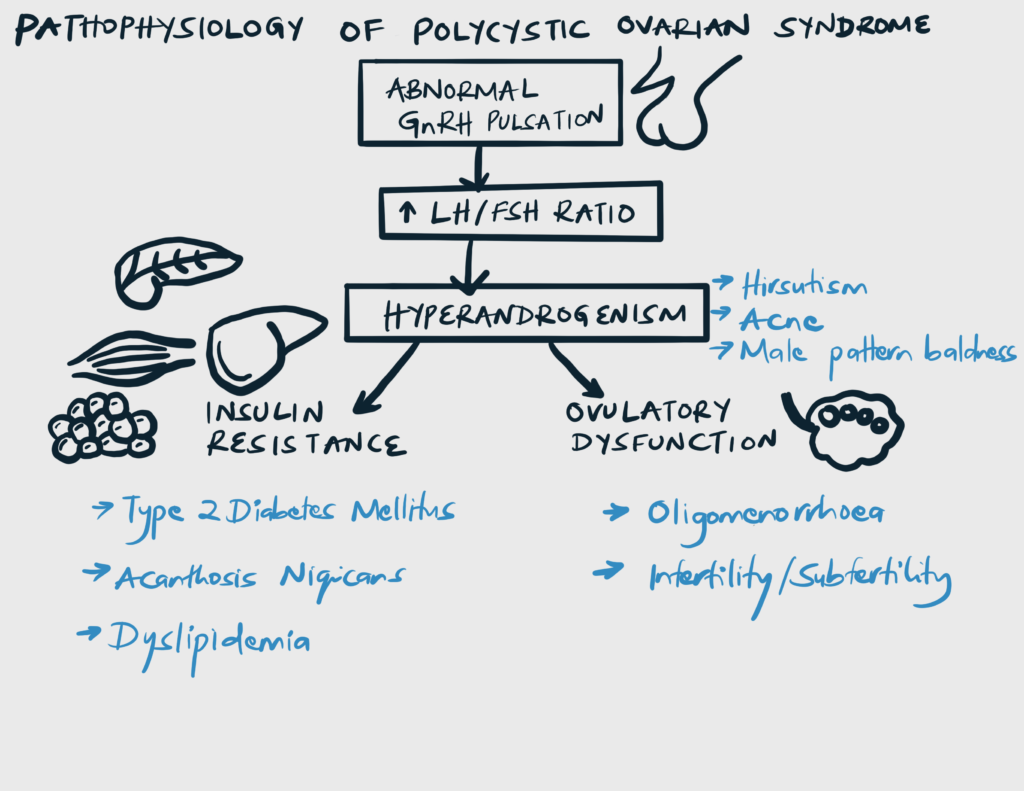
- The basic concept is: insulin resistance → hyperinsulinemia → hyperandrogenism → anovulation
- Insulin resistance:
- Increased ovarian androgen production
- Reduced sex hormone-binding globulin (SHBG)
- Increased free testosterone
- Hyperandrogenism:
- Hyperinsulinameia and luteinizing hormone (LH) stimulate theca cells to produce androgens
- There is also increased peripheral aromatization of androgens to estrone
- Gonadotropin abnormalities:
- The classic LH:FSH ratio is > 2:1 due to increased GnRH pulse frequency
- LH stimulates androgen production
- A relatively low FSH impairs the maturation of follicles
- Follicular dysfunction:
- Selection of a dominant follicle fails
- Multiple arrested follicles accumulate leading to polycystic ovaries
- Chronic estrogen exposure:
- Peripheral aromatization of androgens to estrone leads to chronic unopposed estrogen
- This causes endometrial hyperplasia and increases the risk of endometrial cancer
- Signs and symptoms
- Oligomenorrhoea
- Anovulation or hypo-ovulation due to disturbed LH and FSH levels
- Irregular cycles
- 46 days (1 -3 years post-menarche)
- 35 days (> 3 years post-menarche)
- < 8 cycles per year
- 90-day interval between periods
- Amenorrhoea
- Hirsutism due to increased androgens.
- Terminal hair on the sides of head, upper lip, chin, abdomen, and back.
- It is not the same as hypertrichosis.
- Acne vulgaris due to increased androgens
- Male pattern balding or alopecia due to increased androgens
- Frank viriliztion suggests an androgen-secreting tumor
- Deep voice
- Clitoromegaly
- Increased muscle mass
- Breast atrophy
- Abnormal menstruation due to increased estrogen and low progesterone
- There is a state of unopposed estrogen in PCOS
- Acanthosis nigricans due to insulin resistance
- T2DM (polyuria, polydipsia, and malaise) due to insulin resistance
- Obesity due to low adiponectin
- Polycystic ovaries
- Oligomenorrhoea
- Differentials
- For hypo-ovulation or anovulation:
- Pregnancy
- Hyperprolactinemia
- Use of dopamine antagonists
- Pituitary tumors
- Prolactin secreting tumors
- Hyperthyroidism
- Hypothyroidism
- Hypogonadotropic hypogonadism
- Premature Ovarian Failure (POF)
- Outflow tract obstruction
- For hyperandrogenism:
- Congenital adrenal hyperplasia (21-OHase deficiency), which presents with frank virilization
- Cushing’s syndrome
- Androgen-secreting tumor
- Exogenous androgens
- For hypo-ovulation or anovulation:
- Investigations
- Urine or serum b-HCG to rule out pregnancy
- FSH and LH levels
- LH: FSH >2 is consistent with PCOS.
- Ovulation assessment with mid-luteal progesterone
- Prolactin levels to rule out hyperprolactinemia
- Prolactin may be normal or mildly elevated
- Androgen levels
- Androgens may be normal or mildly elevated
- Markedly elevated androgens may be due to another cause
- 17-OH progesterone levels to rule out non-classical congenital adrenal hyperplasia
- TSH to rule out hypothyroidism
- Lipid profile
- Blood glucose
- Transvaginal ultrasound to visualize the ovaries
- ≥ 20 follicles in at least one ovary
- Chain of pearl appearance of cysts in the ovaries
- Treatment
- Weight loss and dietary modifications
- Combined oral contraceptives (COCs) are the first-line treatment
- Suppress GnRH release → reduce androgens
- The progestin component of COCs reduces endometrial proliferation and the risk of endometrial cancer
- The progestin component also decreases LH levels, which indirectly decreases ovarian androgen production.
- Some progestins have direct anti-androgenic properties by inhibiting 5 alpha-reductase
- Cyclic progestogens if oestrogen containing contraceptives are contraindicated or declined
- Metformin if hormonal contraceptives are contraindicated
- It is commonly used in adolescents
- It restores normal menses and reduces insulin resistance
- It can also mildly improve symptoms of hyperandrogenism
- For acne:
- Topical benzoyl peroxide +/- topical antibiotics
- Topical retinoids
- Oral retinoids
- For hirsutism:
- Eflornithine topical cream
- Spirinolactone if hirsutism persists ≥ 6 months of OCPs
- Laser hair removal
- Cosmetic interventions such as shaving, waxing, and bleaching
- For infertility:
- Lestrozole
- Clomiphene citrate + metformin
- Others treatments:
- Leuprolide (GnRH agonist)
- Statins for dyslipidemia
- GLP-1 receptor agonists (semaglutide)
- Myoinositol
- Surgery:
- Ovarian drilling to reduce androgen production
- Complications
- Dyslipidemia
- Obesity and metabolic syndrome
- Cardiovascular disease
- Type 2 diabetes and impaired glucose regulation
- Endometrial cancer
- Obstructive sleep apnea
- Non alcoholic fatty liver disease
- Anxiety and depression
- Infertility or subfertility
- Early miscarriage
- Gestational hypertension
- Gestational diabetes
- Preterm birth
- Perinatal mortality
Treating PCOS using hormonal contraceptives
| Step | Description | Medications |
|---|---|---|
| Step 1 | Induce withdrawal bleeding using a progestogen. This is done to shed the endometrium before long-term therapy when there is prolonged amenorrhoea. | Medroxyprogesterone acetate or micronized progesterone |
| Step 2 | Introduce oral contraceptives for long-term cycle regulation. This is the first-line treatment if pregnancy is not desired. The progestins listed are preferred because they have lower androgen activity. | Ethinyl estradiol/drospirenone, ethinylestradiol/norgestimate, or ethinylestradiol/desogestrel |
| Alternative step 2 | Cyclic progestogens can be used when estrogen-containing contraceptives are contraindicated or declined. This does not improve hirsutism, acne, or hyperandrogenism. | Medroxyprogesterone acetate or micronized progesterone |