Your first week of Hyperexcision Scholar (Q-bank) is on us. Just use code TRIAL250 at checkout when you purchase the 1-week access and you are sorted. DismissSkip to content
Overview Open fractures are common and have a high potential for morbidity and mortality. They are commonly associated with infection, osteomyelitis, compartment syndrome, and amputation. The tibia is the most commonly involved bone. Classification of Open Fractures The Gustilo-Anderson classification…
Fracture Healing The type of fracture healing is determined by movement around the fracture site. Movement around the fracture site and healing Degree of movement Consequence Absolute stability and compression Primary healing Relative stability Secondary healing Excessive movement Delayed or…
Nomenclature Suffix AKA Description Features -tropia Manifest deviation Binocular vision cannot be obtained. These patients have persistent symptoms. Persistent symptoms -phoria Latent deviation Binocular gaze may be obtained when both eyes are open and fixating, but when the strabismus eye…
Amblyopia is a disorder of the ocular-neural tracts resulting in decreased visual acuity in one or both eyes. It is usually as a results from disorders in the eye itself. It is difficult to elicit symptoms of Amblyopia in infants,…
Overview This refers to impaired vision due to an abnormal focal point of the eye. The cornea performs most of the refraction in the eye. Ideally, the corneal curvature of an eye must match the eye’s size. A mismatch leads…
Overview A cataract is an opacity of the crystalline lens. It causes haziness and cloudiness of vision. It is a painless process. It is treated by surgery. Leukocoria Leukocoria can be a presenting sign of cataracts. It appears as a…
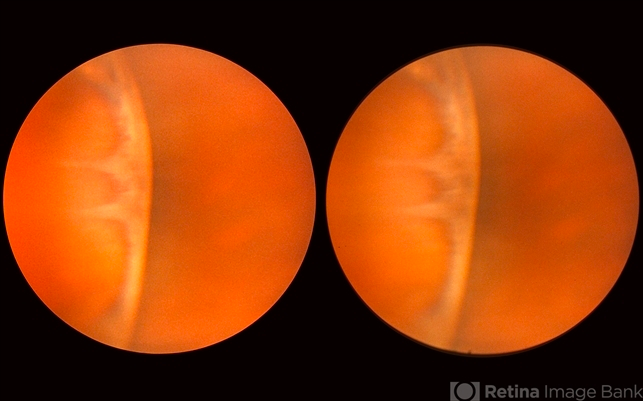
Overview Retinopathy of prematurity is a disease of the retinal vasculature in pre-term and low birthweight infants. It is one of the leading causes of avoidable childhood visual impairment and blindness. The severity of retinopathy of prematurity varies. Screening is…
Retinoblastoma is a neuroectodermal malignancy arising from retinal cells. It is one of the small round blue cell tumors of childhood. It is caused by a mutation of the retinoblastoma gene (RB1) located on chromosome 13q14. Children born with germline…
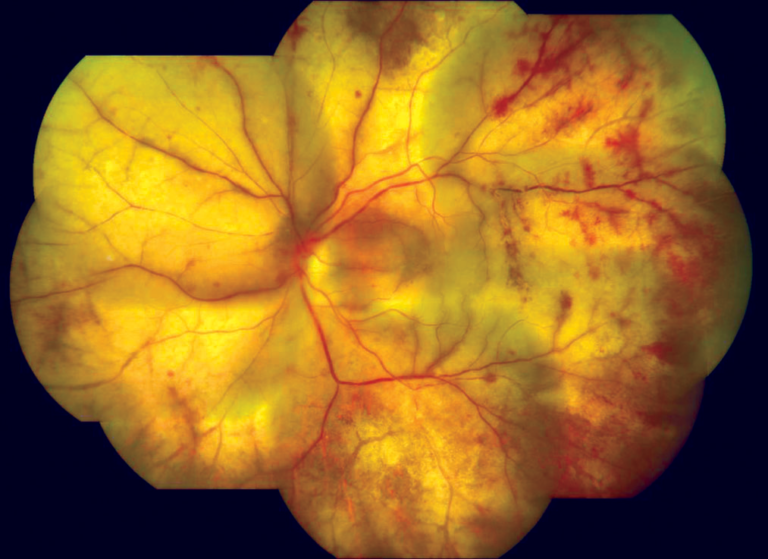
Overview Retinitis occurs in conditions that cause retinal inflammation, resulting in edema and necrosis. Patients typically experience floaters (dark spots in the visual fields) and decreased vision. Infectious retinitis is usually a manifestation of systemic illness. Cytomegalovirus is a classic…
Retinal detachment is the separation of the retina from the retinal pigment epithelium. It is one of the most commonly encountered ophthalmologic emergencies (along with occlusion of the retinal artery, endophthalmitis, and trauma). Retinal detachment has a good prognosis provided…