Distinguish between endochondral and membranous ossification. Give examples
Endochondral ossification
Intramembranous ossification
Definition
Development of bone tissue within cartilage
Development of bone tissue within mesenchymal tissue without cartilage formation
Mechanism
Cartilage is formed first and bone is laid on it
Bone is directly formed from mesenchyme
Intermediate cartilage
Yes
No
Types of bones formed
Long bones
Flat bones
Chondrocytes involved
Yes
No
Osteoclasts involved
Yes
No
Components of the skeleton formed
Long bones of the extremities and axial skeleton
Skull, face, mandible and clavicles
Distinguish between interstitial and appositional growth of cartilage
Interstitial Growth
Appositional growth
Definition
Increase in bone length
Increase in bone width
Growth from
Within
Outside
Location
Lacunae
Pre-existing cartilage
Mechanism
Chondrocytes within divide and secrete matrix. Cartilage lengthens and is replaced by bone tissue
Chondroblasts in the perichondrium secrete matrix. New bone tissue is deposited on the surface of pre-existing bone
Outcome
Longer bones
Thicker bones
What are the structural differences between mature and immature bone
Mature Bone
Immature Bone
Organization
Lamellar bone
Woven bone
Cells per unit area
Less
More
Arrangement of cells
Arranged in their long axes in the same direction as Lamellae
Randomly arranged
Ground substance
Less
More
Name the cell types in bone tissue and their respective functions
Osteoprogenitor cells: Osteogenesis – formation of new bone
Osteoblasts: The differentiated bone forming cell – deposits bone matrix
Osteocytes: The mature bone enclosed by bone matrix
Bone-lining cells: derived from osteoblasts. Cover bone where remodeling is not occurring.
Osteoclasts: Resorption of bone and remodeling.
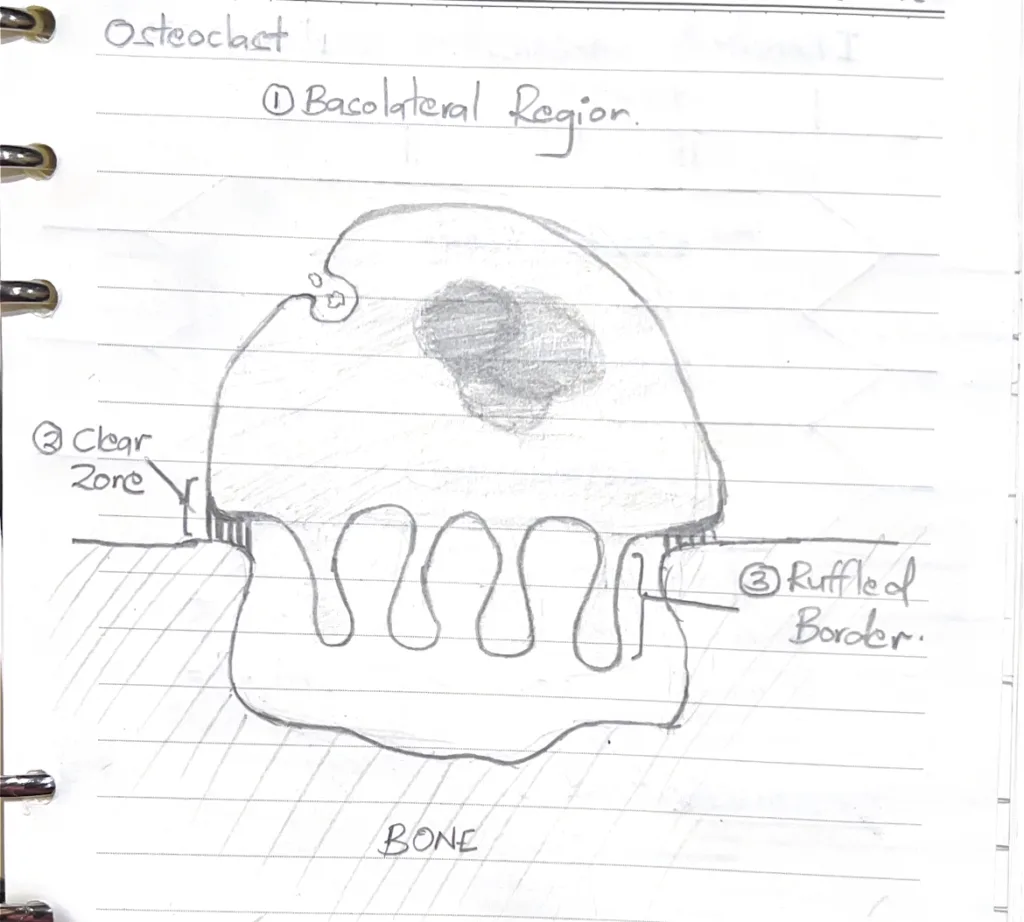
Name the functional zones of an active osteoclast
Ruffled border
Clear zone
Basolateral region
Illustrate the morphological features of an active osteoclast
Zones of an active osteoclast
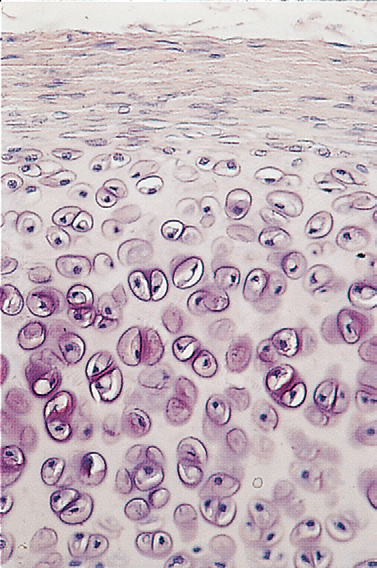
Describe the zonation of the epiphyseal growth plate
Zone of reserve cartilage: No cellular proliferation or active matrix production
Zone of proliferation: Chondrocytes undergo division and organize into distinct columns
Zone of hypertrophy: Contains hypertrophic chondrocytes which have accumulated glycogen
Zone of calcified cartilage: Chondrocytes undergo apoptosis and the matrix becomes mineralized
Zone of resorption: Calcified cartilage here is in direct contact with the connective tissue of the marrow cavity. It is invaded by osteoprogenitor cells which occupy the spaces previously filled by the dead chondrocytes.
To provide the best experiences, we use technologies like cookies to store and/or access device information. Consenting to these technologies will allow us to process data such as browsing behavior or unique IDs on this site. Not consenting or withdrawing consent, may adversely affect certain features and functions.
Functional
Always active
The technical storage or access is strictly necessary for the legitimate purpose of enabling the use of a specific service explicitly requested by the subscriber or user, or for the sole purpose of carrying out the transmission of a communication over an electronic communications network.
Preferences
The technical storage or access is necessary for the legitimate purpose of storing preferences that are not requested by the subscriber or user.
Statistics
The technical storage or access that is used exclusively for statistical purposes.The technical storage or access that is used exclusively for anonymous statistical purposes. Without a subpoena, voluntary compliance on the part of your Internet Service Provider, or additional records from a third party, information stored or retrieved for this purpose alone cannot usually be used to identify you.
Marketing
The technical storage or access is required to create user profiles to send advertising, or to track the user on a website or across several websites for similar marketing purposes.