Your first week of Hyperexcision Scholar (Q-bank) is on us. Just use code TRIAL250 at checkout when you purchase the 1-week access and you are sorted. DismissSkip to content
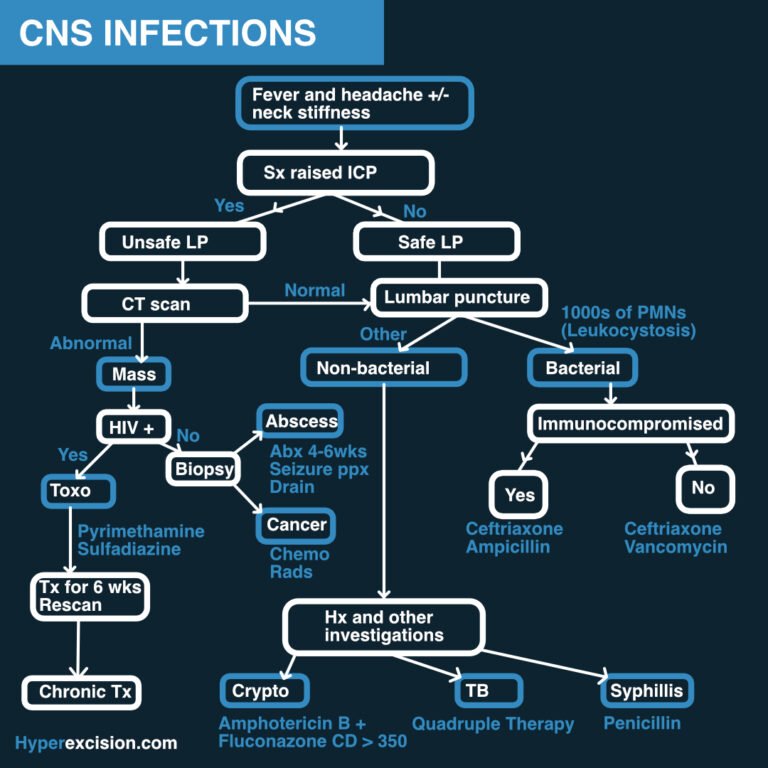
Overview CNS infections carry a high mortality if untreated or improperly treated. It is important to recognize and treat differently neonates, young people, adults, old people, and immunocompromised since different organisms affect these different populations. Infections of the CNS include:…
Condition Description Erysipelas Superficial infection of the upper layers of the dermis. Raised sharply demarcated edges, rapid spread and onset, and fever early in course. Caused by Streptococcus pyogenes. Cellulitis Infection that involves the deeper dermis and subcutaneous tissue. Non-purulent…
Overview Neck trauma includes both blunt and penetrating trauma. The airway is a major concern in neck trauma. Patients who present with hypoxia, stridor, neck distortions, or hematoma should be intubated immediately. Blunt trauma is primarily managed based on symptoms…
Overview Patients do not die from an inability to intubate the trachea…they die from lack of oxygen ASA defines a difficult airway as a clinical situation in which a conventionally trained anaesthesiologist experiences difficulty with facemask ventilation of the upper…
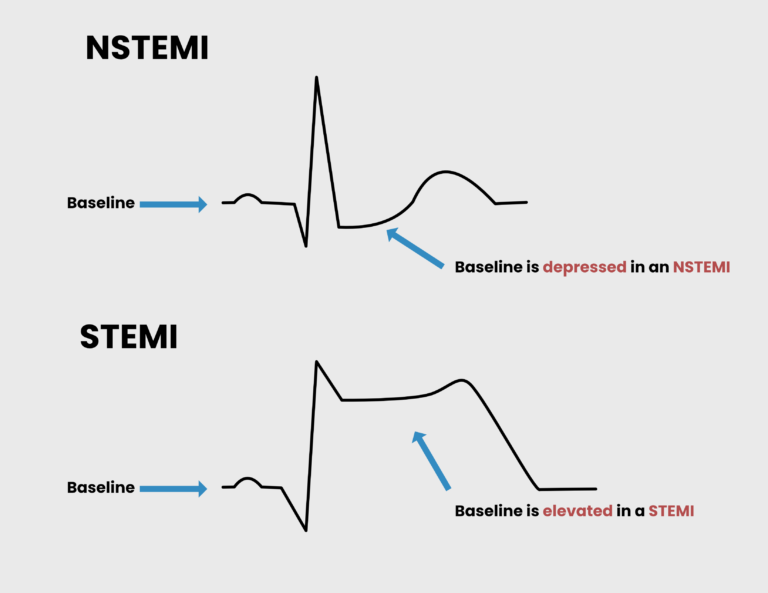
Overview Acute coronary syndrome (ACS) is a spectrum of clinical presentation ranging from ST-segment elevation myocardial infarction (STEMI), non-ST-segment elevation myocardial infarction (NSTEMI), and unstable angina. It is caused by rupture of an atherosclerotic plaque and partial or complete occlusion…
Overview Angina refers to chest pain on exertion. The chest pain is always sub-sternal, and is described as crushing/heavy, lasts minutes to hours, and may radiate to the upper arm or shoulder. 99% of cases are due to coronary artery…
Overview Emphasis in thoracic trauma is on proper airway and breathing (since injury can be to the airway structures themselves). Patients with thoracic trauma should be put on 100% O2 via NRB mask (not nasal cannulas) since hypoxia is an…
Overview Trauma is the leading cause of death and disability in pts < 40yo, and is the third most common cause of death overall. The formula patient + mechanism = injury is key in assessing and managing trauma patients .…
Overview HIV/AIDs is caused by the retrovirus Human Immunodeficiency Virus (HIV-1 and HIV-2). Most patients with acute HIV infection are asymptomatic but some may present with a flu-like illness in the weeks following exposure. Transmission HIV is spread parentally via…
Summary of important cognitive milestones Age Milestones 1 month old Reacts to voice, establishes eye contact 2 months old Tracks object 180 degrees 4 months old Recognizes hand 6 months old Grasps, visualizes, and manipulates objects 9 months old Object…