Overview
An electrocardiogram (ECG/EKG) is a graphical representation of the electrical activity of the heart. It is one of the most common investigations carried out in cardiovascular medicine.
Willem Einthoven developed and added onto previous work on electrical charges in the heart, building the EKG we know and use today. He won the Nobel Prize in Medicine in 1924.
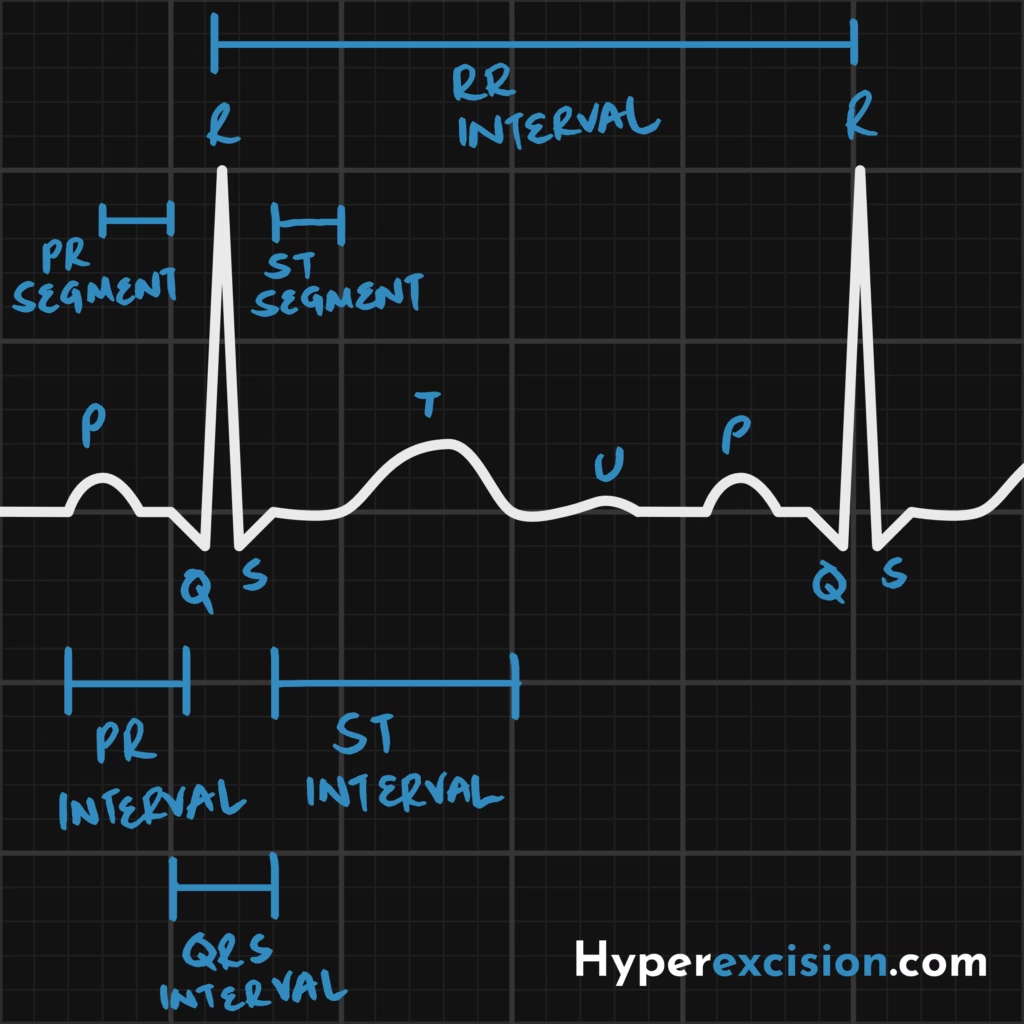
- Normal EKG values
- Heart rate: 60–100 bpm
- PR interval: 0.12–0.20 s (3–5 small squares)
- QRS duration: <0.12 s (≤3 small squares)
- QTc:
- <440 ms (men)
- <460 ms (women)
EKG wave summary
| Component | Represents |
|---|---|
| P wave | Atrial depolarization |
| PR interval | AV nodal delay |
| QRS complex | Ventricular depolarization |
| ST segment | Early ventricular repolarization (should be isoelectric) |
| T wave | Ventricular repolarization |
| QT interval | Total ventricular electrical activity |
Electrical Pathway
To understand an EKG, you must map the electrical impulse to physical contraction.
- Electrical system of the heart
- SA node: Impulse is generated from the sinoatrial node (SA node)
- Atrial depolarization: Depolarization spreads through gap junctions through atrial muscle fibers, causing the atrium to contract. This creates the P wave.
- AV node delay: Depolarization reaches the atrioventricular node (AV node), where it is delayed to allow blood to fill the ventricles. This creates the PR interval.
- Bundle of His: Electrical discharge travels rapidly from the AV node first through the bundle of His, then into the right and left bundle branches. The left bundle branch depolarizes first and then sends current to the right bundle branch. The left bundle branch divides into anterior and posterior fascicles.
- Purkinje fibers: these fibers distribute impulses throughout the ventricular walls
- Ventricular depolarization: This causes ventricular contraction. Depolarization of the ventricles creates the QRS complex
- Ventricular repolarization: Ventricular repolarization creates the T wave.
- Summary of electrical events and EKG correlation
- SA node firing → start of P wave
- Atrial contraction → P wave
- AV node delay → PR interval
- Ventricular depolarization → QRS complex
- Ventricular contraction → occurs during QRS/ST
- Ventricular repolarization → T wave
EKG Leads (Viewpoints of the heart)
The conventional EKG machine consists of 12 leads divided into two groups, i.e., limb leads and precordial leads. Lead refers to the electrical view of the heart. If an impulse moves towards a lead, it shows a positive deflection and vice versa.
Types of leads on an EKG
| Type | Description |
|---|---|
| Limb leads | View the heart in a frontal/coronal plane (from the sides or the feet) |
| Standard limb leads | Includes lead I, II, and III. Bipolar leads (2 electrodes of opposite polarity) and a ground electrode that minimizes activity from the source. Gives 3 views of the heart |
| Augmented limb leads | Includes AvR, AvL, AvF. Gives 3 more angles to look at the heart with the heart at the center (’negative electrode’) |
| Precordial leads | Gives a horizontal view of the heart (from the front/left side to back) |
Standard limb leads
| Lead | Description | View |
|---|---|---|
| Lead I | Right arm (-) to left arm (+) | Lateral view |
| Lead II | Right arm (-) to left leg (+) | Inferior view |
| Lead III | Left arm (-) to left leg (+) | Inferior view from the right |
Augmented limb leads
| Augmented limb lead | View | Nota bene |
|---|---|---|
| aVR | Right atrium | The only electrode that records a negative deflection |
| aVL | Left lateral view | |
| aVF | Inferior surface |
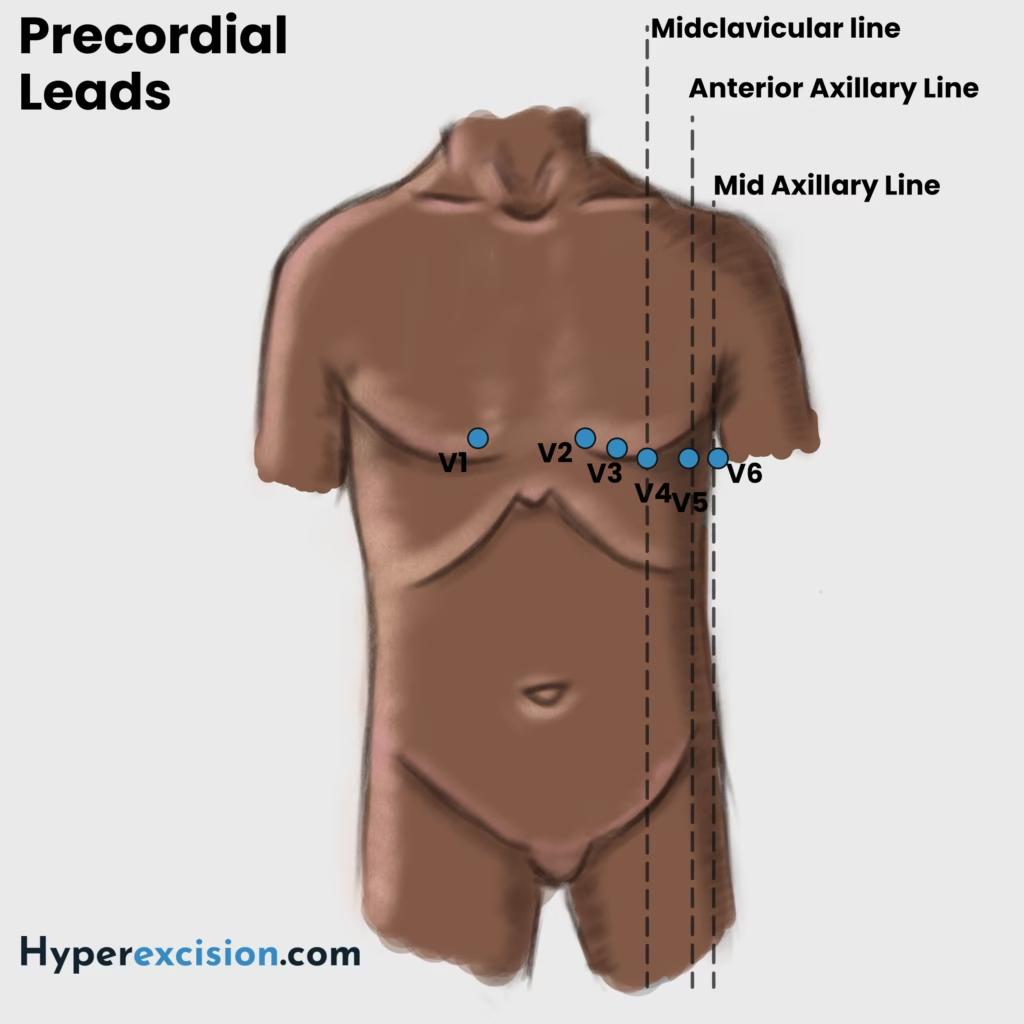
Precordial leads
| Precordial lead | Positive electrode placement | View |
|---|---|---|
| V1 | 4 ICS to the right of the sternum | Septal |
| V2 | 4 ICS to the left of the sternum | Septal |
| V3 | Between V2 and V4 | Anterior |
| V4 | 5 ICS in left MCL | Anterior |
| V5 | Level with V4 at the left anterior axillary line | Lateral |
| V6 | Level with V5 at the left midaxillary line | Lateral |
EKG territories
| Leads | Territory | Artery |
|---|---|---|
| II, III, aVF | Inferior | Right coronary artery (RCA) |
| V1–V4 | Anterior/Septal | Left anterior descending (LAD) |
| I, aVL, V5–V6 | Lateral | Left circumflex (LCX) |

EKG Paper and Grid
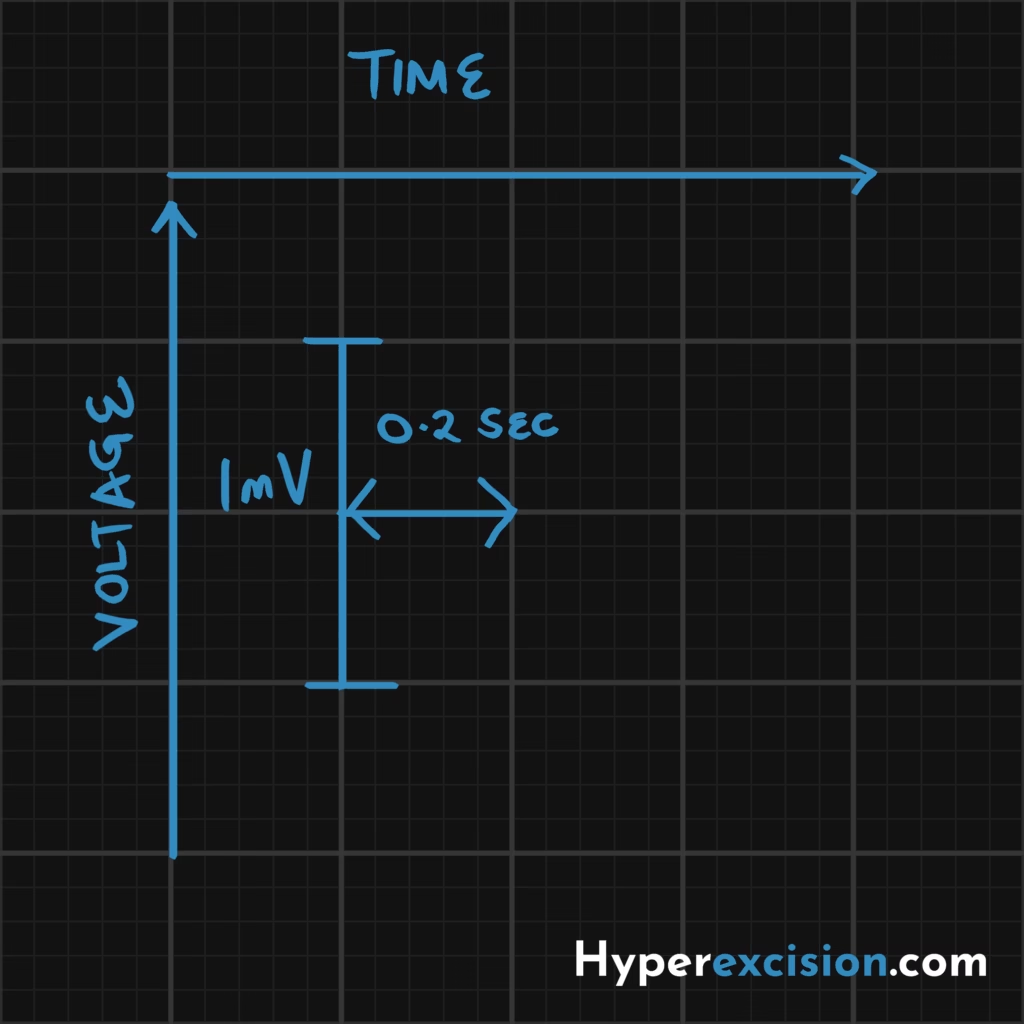
The EKG machine records electrical activity on a graph paper moving at a standard speed of 25 mm/sec.
The vertical axis measures voltage (1mV = 10 mm or 2 large squares) while the horizontal axis measures time
EKG grid
| Unit | Voltage/distance (vertical axis) | Time (horizontal axis) |
|---|---|---|
| 1 small square | 1mm | 0.04 seconds |
| 1 large square | 5 mm | 0.20 seconds |
| 5 large squares | 25 mm | 1.0 seconds |
Calibration:
1 mV – 10 mm (2 large squares)
Electrical Direction and EKG Deflections
| Direction | Deflection |
|---|---|
| Positive charge towards a positive electrode | Positive deflection |
| Positive charge away from a positive electrode | Negative deflection |
| Electrical activity moving perpendicular to a lead | Isoelectric (flat) line |
| Negative charge towards the negative electrode | Positive deflection (seen in repolarisation) |
Step-by-step Interpretation of an EKG
1. Confirm details and Calibration
Is the EKG recorded correctly and for the right patient?
- Patient name, age, date, and time
- Paper speed 25 mm/sec
- Calibration 10 mm = 1 mv
- Check for artifacts or poor lead placement
2. Rate
How fast is the heart beating?
The normal rate is 60 – 100 bpm.
- Quick methods to calculate the rate
- Large square method: 300 divided by the number of large squares between R waves.
- Small square method: 1500 divided by the number of small squares between R waves
- 6-second method for irregular rhythms: count QRS complexes in 6 seconds (30 large squares), then multiply by 10
3. Rhythm
Is the heartbeat regular, and is it sinus (P before every QRS)?
- Characteristics of a normal sinus Rhythm
- A P wave before every QRS
- A QRS after every P wave
- P waves all look the same
- The R-R interval is constant
- Rate of 60-100
- The PR interval is not prolonged (0.12)
- Quick method to check rhythm
- Card method: lay a card along the EKG and mark the positions of three successive R waves. Slide the card to and fro, checking whether the intervals are equal.
- Common rhythm patterns
- Irregularly irregular rhythm → Atrial fibrillation
- Regular narrow complex tachycardia → SVT
- Regular wide complex tachycardia → Ventricular tachycardia (until proven otherwise)
- No P waves + chaotic baseline → Atrial fibrillation
- Sawtooth P waves → Atrial flutter
4. Axis
Is the QRS axis normal, left, or right?
Axis is the overall direction of depolarization across the anterior chest. It is the sum of all ventricular electrical forces during depolarisation. Use lead I and aVF to quickly estimate the axis. Lead I looks at the heart from the left side (0 degrees) while aVF looks at the heart from the feet (90 degrees). The normal adult axis is approximately (-) 30 degrees to (+) 90 degrees.
| Lead I | aVF | Interpretation |
|---|---|---|
| Positive | Positive | Normal Axis |
| Positive | Negative | Left Axis Deviation |
| Negative | Positive | Right Axis Deviation |
| Negative | Negative | Extreme Axis |
- Causes of left axis deviation
- Left anterior hemiblock
- Inferior MI
- Ventricular tachycardia from a left ventricular focus
- Wolff-Parkinson-White syndrome
- Left ventricular hypertrophy
- Causes of right axis deviation
- Right ventricular hypertrophy
- Pulmonary embolism
- Anterolateral MI
- Wolff-Parkinson-White syndrome
- Left posterior hemiblock
5. P wave morphology
How are the atria?
P-waves are evaluated mainly in lead II and V1. A P wave normally precedes each QRS complex. It is upright in II, III, and aVF but inverted in aVR.
- Analyzing P waves
- Are P waves present?
- Is there exactly one P wave for every QRS complex?
- Are the P waves upright in Lead II? (If the P wave is inverted, the signal may be starting from somewhere other than the SA node.)
- P-wave abnormalities
- Absent P wave: Atrial fibrillation
- Hidden P wave: Junctional or ventricular rhythm
- Bifid P wave: P mitrale indicating left atrial hypertrophy
- Peaked P wave: P pulmonale indicating right atrial hypertrophy. Pseudo-p-pulmonale may be seen in hyperkalaemia
6. Intervals and Durations
Are the timings correct?
Is the PR interval normal in length?
Is the QRS narrow or wide?
Are there abnormal Q waves or unusual voltages?
Is the QT interval prolonged?
- PR interval ranges from 0.12 – 0.20s (3 – 5 small squares)
- Prolonged PR interval: 1st degree heart block
- QRS complex is normally < 0.12 seconds (3 small squares) wide
- > 0.12 seconds (3 small squares): ventricular conduction defect (e.g. bundle branch block), metabolic disturbance, or ventricular origin (ventricular ectopic).
- High amplitude QRS complex: ventricular hypertrophy
- Q waves are < 0.04 s (1 small square) wide and < 2mm (2 small squares) deep. They are seen in leads I, aVL, V5, and V6 and reflect normal septal depolarization.
- Deep and wide Q-waves: pathological Q waves occuring a few hours after an acute MI
- QT interval varies with rate. QTc (corrected QT interval) is the QT interval divided by the square root of the R-R interval: QTc=QT/√RR. It is normally 0.38 – 0.42 seconds.
- Long QT: Many conditions predispose to a long QT. A long QT interval leads to ventricular tachycardia and sudden death
7. ST Segment and T waves
Is there ST elevation or depression?
Are the T waves upright and narrow?
- ST segment should be flat (isoelectric)
- ST elevation (> 1mm in limb leads and ≥ 2 mm in chest leads ): STEMI
- ST depression (> 0.5 mm): NSTEMI or reciprocal changes
- J point is where the S wave ends, and the ST segment starts
- J wave: notch at the J point seen in hypothermia, subarachnoid hemorrhage, and hypercalcaemia.
- T waves should be upright in most leads. They are normally inverted in aVR, V1, and occasionally V2.
- Tall and peaked T waves: hyperacute T waves seen in hyperkalaemia
- Flattened T waves: seen in hypokalaemia
- Inverted T waves: abnormal in leads I, II, and v4 – V6
- U wave: a small wave after the T wave. Seen in hypokalaemia, bradycardia, and with certain drugs.