Abnormal uterine bleeding is defined as menstrual blood loss (MBL) that interferes with physical, social, and mental quality of life, irrespective of the regularity, frequency, or duration (NICE)
Non-menstrual bleeding (postcoital, intermenstrual or post-menopausal bleeding) always warrants further investigation and early referral to a gynaecologist.
Normal vs Abnormal parameters for menstrual bleeding
| Parameter | Normal Range | Nota bene |
|---|---|---|
| Menarche | 10 – 16 years (mean age 13) | Irregular periods from 3 years after menarche |
| Cycle Frequency | 21–35 days | <21 is polymenorrhoea while >35 days is oligomenorrhoea |
| Bleeding Duration | 2–7 days | > 7 days suggest heavy menstrual bleeding |
| Menstrual blood loss Volume | 5–80 mL/cycle | >80 mL is heavy menstrual bleeding |
| Cycle Regularity | Variation < 9 days | Variation ≥ 9 days is abnormal |
| Endometrial thickness (pre-menopausal) | 6 – 12 mm | Abnormal if thickness is out of phase or exceeds 16 mm in secretory phase |
| Endometrial thickness (post-menopausal bleeding) | < 4 mm | Can be up to 8 mm if there is hormonal replacement therapy |
FIGO Classification of Abnormal Uterine Bleeding(PALM-COEIN)
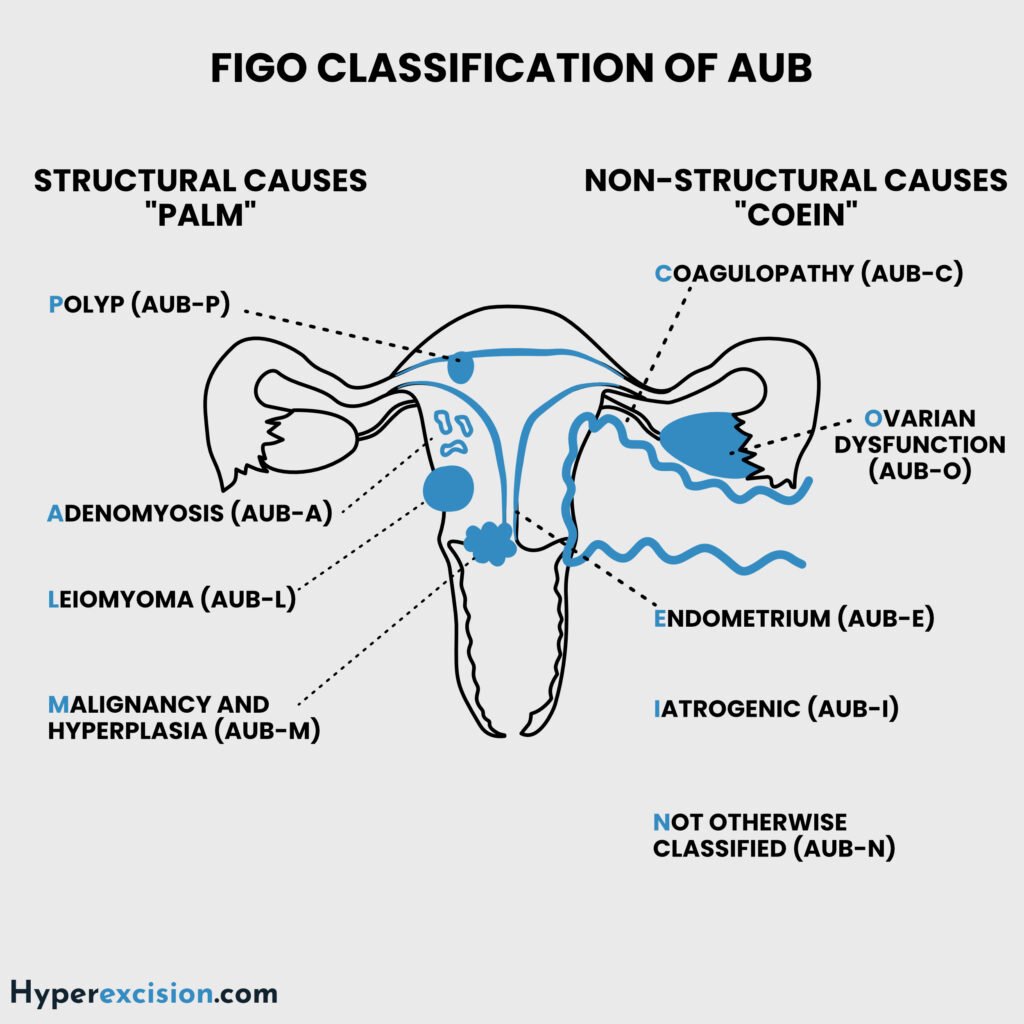
Structural Causes (PALM)
| Acronym | Description |
|---|---|
| P | Polyps (AUB-P) |
| A | Adenomyosis (AUB-A) |
| L | Leiomyoma (AUB-L; submucosal most relevant) |
| M | Malignancy or hyperplasia (AUB-M) |
Non-Structural Causes (COEIN)
| Acronym | Description |
|---|---|
| C | Coagulopathy (AUB-C; e.g. von Willebrand disease) |
| O | Ovulatory dysfunction (AUB-O; commonly anovulation) |
| E | Endometrial (AUB-E; primary disorder) |
| I | Iatrogenic (AUB-I; e.g. anticoagulants, IUD) |
| N | Not classified e.g. niche, arteriovenous malformation |
- Some terms used to describe abnormal uterine bleeding
- Heavy menstrual bleeding (HMB)
- Intermenstrual bleeding (IMB)
- Postcoital bleeding
- Postmenopausal bleeding
- Oligomenorrhoea and amenorrhoea
- Dysfunctional uterine bleeding
- Irregular menstrual cycle
- Pathogenesis of uterine bleeding
- Fibrinolytic Pathway Dysregulation:
- Progesterone controls fibrinolysis.
- Increased Tissue plasminogen activator (tPA) > PAI-1 → Excessive clot breakdown
- Prostaglandin Imbalance:
- Increased PGE₂ (vasodilatory) vs. reduced PGF₂α (vasoconstrictive) → Increased blood flow
- Endometrial Inflammation:
- ↑ TNF-α, IL-1β → disrupted vascular integrity
- Fibrinolytic Pathway Dysregulation:
- Patient History
- Adolescents:
- AUB-O most common – inferquent cycles, painless prolonged or HMB
- Rule out coagulopathy (e.g., VWD in 20%) – HMB since menarche
- Perimenopause:
- Exclude endometrial hyperplasia/cancer first.
- HMB Indicators:
- Soaking >2 pads/hour
- Changing pads every 3 hours
- More than 20 pads used in 1 cycle
- Passing clots > 1 inch
- Needs extra pads in the night
- Bleeding soils clothing or bedsheets
- Flow lasts > 7 days
- Signs and symptoms of anaemia
- Menstrual Patterns:
- Cyclical HMB = AUB-L (submucosal), AUB-A, AUB-C, AUB-E
- Cyclical IMB = AUB-P (benign or malignant)
- Acyclical HMB = Malignancy
- Acyclical IMB = AUB-O
- IMB and Post-coital bleeding = exclude malignancy and polyps
- Red Flags:
- Postmenopausal bleeding
- Weight loss
- Family history of malignancy (Lynch syndrome/BRCA)
- Adolescents:
- Investigations
- B-hCG to rule out pregnancy
- Transvaginal ultrasound to measure endometrial thickness and identify structural lesions
- Normal or thick endometrium = hyperestrogenic (hyperplasia with or without atypial – will respond to progesterone)
- Thin endometrium = low estrogen level (less risk of malignancy, may not respond to progesterone initially)
- Complete blood count and iron panel to assess for iron deficiency anaemia
- Endometrial biopsy for high-risk patients – if age >45 or unopposed estrogen exposure
- Hysteroscopy to identify for focal lesions
- Coagulation panel
- Treatment
- Keep a menstrual calendar
- NSAIDS and Tranexamic or mefanamic acid for 5 days (first-line)
- Controls bleeding in 60 – 80% of patients
- Tranexamic acid reduces MBL by 40 – 50%
- NSAIDs reduce bleeding by 30%
- High-Dose Progestin, e.g., Norethisterone for 10 days
- To stabilize the endometrium
- Combined oral contraceptive pills:
- 80% of patients respond to COCs
- Hormonal IUD (MIrena/LNG-IUD) is most effective hormonal agent
- It reduces bleeding by 95%
- Temporary Balloon tamponade
- Hysteroscopic resection of polyps or submucosal fibroids
- Endometrial ablation for refracotry AUB-E (contraindicated if future fertility is desired)
- Hysterectomy