Vulvar Cysts and Abscesses

Last updated: November 11, 2024

Anatomy of the Vulva

Anatomy of the Vulva
Glands of the vulva
Glands of the vulva

Epidermal Inclusion Cyst

Epidermal inclusion cysts are caused by the proliferation of epidermal cells within a circumscribed area of the dermis which results in plugging of a pilosebaceous unit. It is AKA epidermoid cyst or sebaceous cyst. Usually an incidental finding on physical exam. Diagnosis is clinical.

  • Patient History
    • UV exposure
    • HPV exposure
  • Symptoms
    • Most are asymptomatic
    • Pain/Tenderness
    • Odor and pus when infected
  • Physical exam
    • Flesh-colored cyst < 1cm in diameter
    • Overlying erythema and tenderness if infected
    • There may be cysts elsewhere
  • Treatment
    • Non-infected cyst:
      • No management required
      • Elective excision if patient finds it disfiguring
    • Infected cyst:
      • Incision and drainage
      • Followed by anti-staph antibiotics (Dicloxacillin, Cephalexin)

Hidradenoma

A hidradenoma is a benign cyst of the apocrine sweat gland. AKA apocrine hidradenoma or apocrine sweat gland cyst. Some patients may have a predilection towards abscess formation.

Hidradenitis suppurativa: a chronic disease characterized by recurrent hidradenomas with abscesses. Keloids may form following incision and drainage and hidradenomas may recur leading to chronic scarring. ****

Fox-Fordyce disease: a chronic disease characterized by recurrent non-infected hidradenomas. Worsened by exposure to heat and humidity

  • Patient History
    • Similar cysts elsewhere
  • Symptoms
    • Usually asymptomatic
  • Physical exam
    • Mobile 1-1.5cm nodule which may be ulcerated or inflamed
  • Treatment
    • Non-infected cysts
      • No treatment required
      • Elective excision if the patient finds it disfiguring
    • Infected cysts
      • Incision and drainage
      • Followed by anti-staph antibiotics (e.g. Dicloxacillin, Cefalexin)
    • Hidradenitis suppurativa
      • Incision and drainage
      • Long-term antibiotics (e.g. Doxycycline, Minocycline)
      • Surgery for refractory cases (Laser and phototherapy, Radical surgery to remove the pilosebaceous unit)

Bartholin Gland Cyst and Abscess

Bartholin cysts are caused by obstruction and cystic dilation of Bartholin’s duct. Diagnosis is clinical. Get a good sexual history to rule out chlamydia or gonococcal infection (chronic inflammation obstructs the orifice of the duct leading to cystic dilatation). Bartholin cysts in women over 40 years of age should be biopsied due to a small risk of Bartholin’s adenocarcinoma (a rare cause of vulvar carcinoma).

Bartholin’s glands are a paired set of glands found roughly at the 4 and 8 o’clock position of the vulva. They secrete mucus responsible for lubrication. Each gland is about 0.5 cm in size and drains into a duct 2.5 cm long. Ducts emerge onto the vestibule on either side of the vaginal orifice just inferior to the hymenal ring. They are homologous to the bulbourethral glands in males

  • Patient history
    • Reproductive age (commonly)
    • History of trauma or non-specific infection
    • History of chlamydia or Gonorrhea (in women with abscess)
  • Symptoms
    • Small cysts are asymptomatic
    • Dyspareunia and Pain (for large cysts and abscesses)
      • worsened with walking and sitting
  • Physical exam
    • Unilateral, round-ovoid cyst at the vaginal orifice
    • Fluctuant or tense to palpation
    • Distortion of vulvar symmetry in larger cysts
  • Treatment
    • Small, asymptomatic cysts
      • No intervention is required (may regress on their own)
    • Large, symptomatic cysts or abscesses
      • Incision and Drainage
      • Marsupialisation (Cut cyst and leave a big hole. More invasive, can damage nerves and lead to scarring) or
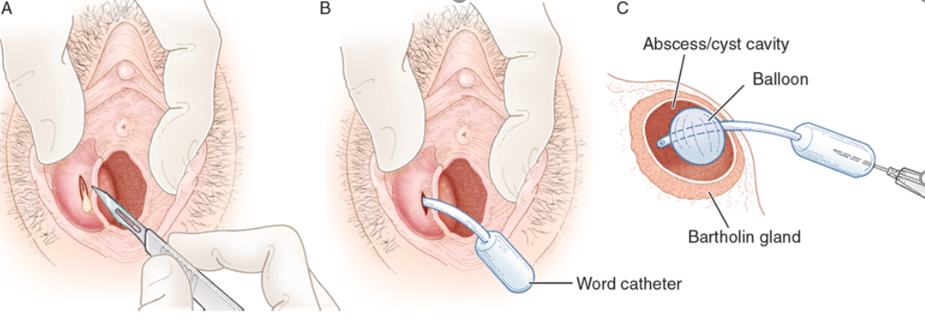
      • Placement of a word-catheter
      • Antibiotics post-I&D especially for women with confirmed Chlamydial or Gonococcal disease
Marsupialization
Marsupialization
Placement of a word catheter

Bartholin Gland Carcinoma

Rare adenocarcinoma. Most affected women do not have a history of Bartholin abscesses or cyst.

  • Signs and symptoms
    • Solid, cystic or abscesses
    • Fixed on underlying tissue
    • Solid area may be noted within cyst
    • Painless vulvar mass
  • Investigations
    • Biopsy
Reference Intervals
Biochemistry
ACTHP: <80 ng/L
ALTP: 5–35 U/L
AlbuminP: 35–50 g/L
AldosteroneP: 100–500 pmol/L
Alk. phosphataseP: 30–130 U/L
α-AmylaseP: 0–180 IU/dL
α-FetoproteinS: <10 kU/L
Angiotensin IIP: 5–35 pmol/L
ADHP: 0.9–4.6 pmol/L
ASTP: 5–35 U/L
BicarbonateP: 24–30 mmol/L
BilirubinP: 3–17 μmol/L
BNPP: <50 ng/L
CRPP: <10 mg/L
CalcitoninP: <0.1 mcg/L
Calcium (ionized)P: 1.0–1.25 mmol/L
Calcium (total)P: 2.12–2.60 mmol/L
ChlorideP: 95–105 mmol/L
CholesterolP: <5.0 mmol/L
VLDLP: 0.128–0.645 mmol/L
LDLP: <2.0 mmol/L
HDLP: 0.9–1.93 mmol/L
Cortisol AMP: 450–700 nmol/L
Cortisol MidnightP: 80–280 nmol/L
CK ♂P: 25–195 U/L
CK ♀P: 25–170 U/L
CreatinineP: 70–100 μmol/L
FerritinP: 12–200 mcg/L
FolateS: 2.1 mcg/L
FSHP: 2–8 U/L ♂; >25 menopause
GGT ♂P: 11–51 U/L
GGT ♀P: 7–33 U/L
Glucose (fasting)P: 3.5–5.5 mmol/L
Growth hormoneP: <20 mu/L
HbA1C (DCCT)B: 4–6%
HbA1C (IFCC)B: 20–42 mmol/mol
Iron ♂S: 14–31 μmol/L
Iron ♀S: 11–30 μmol/L
Lactate (venous)P: 0.6–2.4 mmol/L
Lactate (arterial)P: 0.6–1.8 mmol/L
LDHP: 70–250 U/L
LHP: 3–16 U/L
MagnesiumP: 0.75–1.05 mmol/L
OsmolalityP: 278–305 mosmol/kg
PTHP: 0.8–8.5 pmol/L
PotassiumP: 3.5–5.3 mmol/L
Prolactin ♂P: <450 U/L
Prolactin ♀P: <600 U/L
PSAP: 0–4 mcg/mL
Protein (total)P: 60–80 g/L
Red cell folateB: 0.36–1.44 μmol/L
Renin (erect)P: 2.8–4.5 pmol/mL/h
Renin (recumbent)P: 1.1–2.7 pmol/mL/h
SodiumP: 135–145 mmol/L
TBGP: 7–17 mg/L
TSHP: 0.5–4.2 mU/L
T4P: 70–140 nmol/L
Free T4P: 9–22 pmol/L
TIBCS: 54–75 μmol/L
TriglyceridesP: 0.50–2.3 mmol/L
T3P: 1.2–3.0 nmol/L
Troponin TP: <0.1 mcg/L
Urate ♂P: 210–480 μmol/L
Urate ♀P: 150–390 μmol/L
UreaP: 2.5–6.7 mmol/L
Vitamin B12S: 0.13–0.68 nmol/L
Vitamin DS: 50 nmol/L
Arterial Blood Gases
pH7.35–7.45
PaCO₂4.7–6.0 kPa
PaO₂>10.6 kPa
Base excess±2 mmol/L
Urine
Cortisol (free)<280 nmol/24h
Hydroxyindole acetic acid16–73 μmol/24h
Hydroxymethylmandelic acid16–48 μmol/24h
Metanephrines0.03–0.69 μmol/mmol cr.
Osmolality350–1000 mosmol/kg
17-Oxogenic steroids ♂28–30 μmol/24h
17-Oxogenic steroids ♀21–66 μmol/24h
17-Oxosteroids ♂17–76 μmol/24h
17-Oxosteroids ♀14–59 μmol/24h
Phosphate (inorganic)15–50 mmol/24h
Potassium14–120 mmol/24h
Protein<150 mg/24h
Protein/creatinine ratio<3 mg/mmol
Sodium100–250 mmol/24h
Haematology
WCC4.0–11.0 ×10⁹/L
RBC ♂4.5–6.5 ×10¹²/L
RBC ♀3.9–5.6 ×10¹²/L
Hb ♂130–180 g/L
Hb ♀115–160 g/L
PCV ♂0.4–0.54 L/L
PCV ♀0.37–0.47 L/L
MCV76–96 fL
MCH27–32 pg
MCHC300–360 g/L
RDW11.6–14.6%
Neutrophils2.0–7.5 ×10⁹/L (40–75%)
Lymphocytes1.0–4.5 ×10⁹/L (20–45%)
Eosinophils0.04–0.44 ×10⁹/L (1–6%)
Basophils0–0.10 ×10⁹/L (0–1%)
Monocytes0.2–0.8 ×10⁹/L (2–10%)
Platelets150–400 ×10⁹/L
Reticulocytes0.8–2.0% / 25–100 ×10⁹/L
Prothrombin time10–14 s
APTT35–45 s
Paediatric
Pulse Rate (bpm)
Neonate140–160
Infant <1yr120–140
1–5 years110–130
5–12 years80–120
>12 years70–100
Respiratory Rate (tachypnoea)
0–2 months≥60/min
2–12 months≥50/min
1–5 years≥40/min
>5 years≥30/min
Blood Pressure (mmHg)
Term65/45
1 year75/50
4 years85/60
8 years95/65
10 years100/70
Weight Formulas
3–12 months(a + 9)/2 kg
1–6 years2a + 8 kg
>6 years(7a − 5)/2 kg
Haemoglobin (g/dL)
Term newborn13–20
1 month11–18
2 months10–15
1–2 years10–13
>2 years11–14
MUAC (6 months–5 years)
Obese>17.5 cm
Normal13.5–17.4 cm
At risk12.5–13.4 cm
Moderate malnutrition11.5–12.4 cm
Severe malnutrition<11.5 cm
Developmental Milestones
Social smile1.5 months
Head control4 months
Sits unsupported7 months
Crawls10 months
Stands unsupported10–12 months
Walks12–13 months
Talks18 months
CSF WBC (/mm³)
Term newborn0–25
>2 weeks0–5
Calculator

Post Discussion

Your email address will not be published. Required fields are marked *