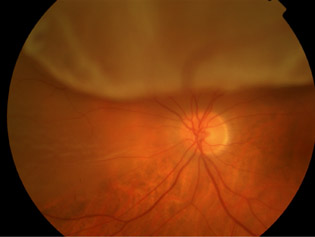
Retinal detachment is the separation of the retina from the retinal pigment epithelium. It is one of the most commonly encountered ophthalmologic emergencies (along with occlusion of the retinal artery, endophthalmitis, and trauma). Retinal detachment has a good prognosis provided it is diagnosed early and the macula is spared. Late diagnosis can lead to total loss of vision in the affected eye. Patients typically present with acute peripheral loss of vision in the affected eye (described as cloudy or curtain-like). Visual acuity can be preserved provided the macula is not detached.
1 in 300 individuals develop retinal detachment in their lives. The incidence increases with age. It is commonly seen in patients aged 40-70 years. 25% of patients with retinal detachment will develop retinal detachment in the contralateral eye at some point in their lives.
Mechanisms of Retinal Detachment (RD)
Mechanism
Pathophysiology
Patient History
Exudative (Serous) RD
Accumulation of serous/hemorrhagic fluid in the subretinal space due to hydrostatic force or acute inflammation
Severe hypertension, Central Retinal Vein Occlusion, Neoplastic Effusion
Tractional RD
Centripetal mechanical force on the retina due to pre-existing scars tears the retina from the RPE
Past inflammatory process, diabetic retinopathy, trauma/injury, past surgery, Retinopathy of Prematurity
Rhegmatogenous RD
Normal senescent changes in the vitreous (becomes more liquefied) cause posterior vitreous detachment which can tear the retina. Vitreous fluid then fills the subretinal space and detatches the retina.
Most common form.
Risk factors
Age
Myopia (probably because an elongated eye may stretch the retina and cause it to weaken)
Previous Cataract Surgery (due to placement of an IOL)
To provide the best experiences, we use technologies like cookies to store and/or access device information. Consenting to these technologies will allow us to process data such as browsing behavior or unique IDs on this site. Not consenting or withdrawing consent, may adversely affect certain features and functions.
Functional
Always active
The technical storage or access is strictly necessary for the legitimate purpose of enabling the use of a specific service explicitly requested by the subscriber or user, or for the sole purpose of carrying out the transmission of a communication over an electronic communications network.
Preferences
The technical storage or access is necessary for the legitimate purpose of storing preferences that are not requested by the subscriber or user.
Statistics
The technical storage or access that is used exclusively for statistical purposes.The technical storage or access that is used exclusively for anonymous statistical purposes. Without a subpoena, voluntary compliance on the part of your Internet Service Provider, or additional records from a third party, information stored or retrieved for this purpose alone cannot usually be used to identify you.
Marketing
The technical storage or access is required to create user profiles to send advertising, or to track the user on a website or across several websites for similar marketing purposes.