
Overview
Pregnancy is the state of having products of conception in the uterus or elsewhere, be it normally or abnormally. Amenorrhea is the most common presentation of pregnancy.
Pregnancy states
| Term | Definition |
|---|---|
| Intrauterine pregnancy (IUP) | Products of conception are implantated in the uterine cavity. Viable IUP is determined by the presence of gestational sac in the endometrial cavity, double decidual sign and fetal pole with cardiac activity. Non-viable IUP is seen in a blighted ovum, miscarriage or intrauterine fetal death |
| Ectopic pregnancy | Products of conception are implanted outside the uterine cavity, either in the fallopian tubes, ovaries cervix, caesarean section scar or abdominal cavity |
| Molar pregnancy | This is a non-viable pregnancy state characterized by abnormal products of conception due to genetic anomaly. It is a product of “how the egg was fertilized” or the “state of the egg during fertilization” e.g. empty egg. It results in gestational trophoblastic disease (GTD) |
- Signs and symptoms of pregnancy
- Amenorrhoea (Amenorrhea is the most common presentation of pregnancy)
- Nausea and Vomiting
- Breast tenderness and swelling
- Quickening: fetal movement felt during the first few months of pregnancy. Occurs approximately 16 – 18 weeks in primigravidas and 18 – 20 weeks in multigravidas.
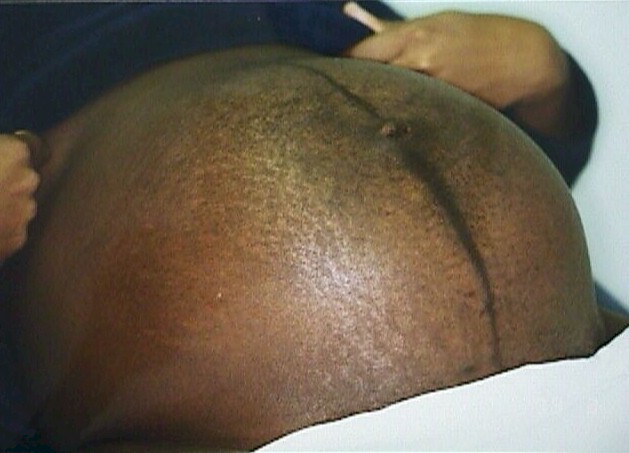
- Linea nigra: dark pigmentation of the skin over the linea alba. Occurs in 75% of pregnant women by 20 – 22 weeks LNMP Melanocyte Stimulating Hormone production by the placenta increases
- Chloasma: Hyperpigmentation of the cheeks, nose, upper lip and forehead seen at 24 weeks LNMP
- Striae gravidarum: linear hypopigmented streaks that appear on the abdomen due to collegen degradation as a result of rapid skin stretching
- Palmar erythema
- Telangiectasia
- Montgomery tubercles: Enlarged sebaceous glands of the areola
Pelvic examination signs in pregnancy
| Sign | Description |
|---|---|
| Goodell’s sign | Softening and bluish discolouration of the cervix at 6 weeks LNMP. This is also seen in OCP users. |
| Jacquemier’s (Chadwick) Sign | Bluish (dusky) disclouration of the anterior vaginal wall due to vascular congestion at 8 weeks LNMP. This is also seen with pelvic tumors |
| Osiander’s sign | Increaed pulsation felt through the lateral fornices at 8 weeks LNMP. This is also seen in pelvic inflamatory disease |
| Palmer’s sign | Regular and rhythmic uterine contractions felt during bimanual examination between 4 – 8 weeks LNMP |
| Hegar’s sign | Abdominal and vaginal fingers seem to oppose below the body of the uterus during bimanual examination at 6 – 10 weeks LNMP |

Diagnosing pregnancy
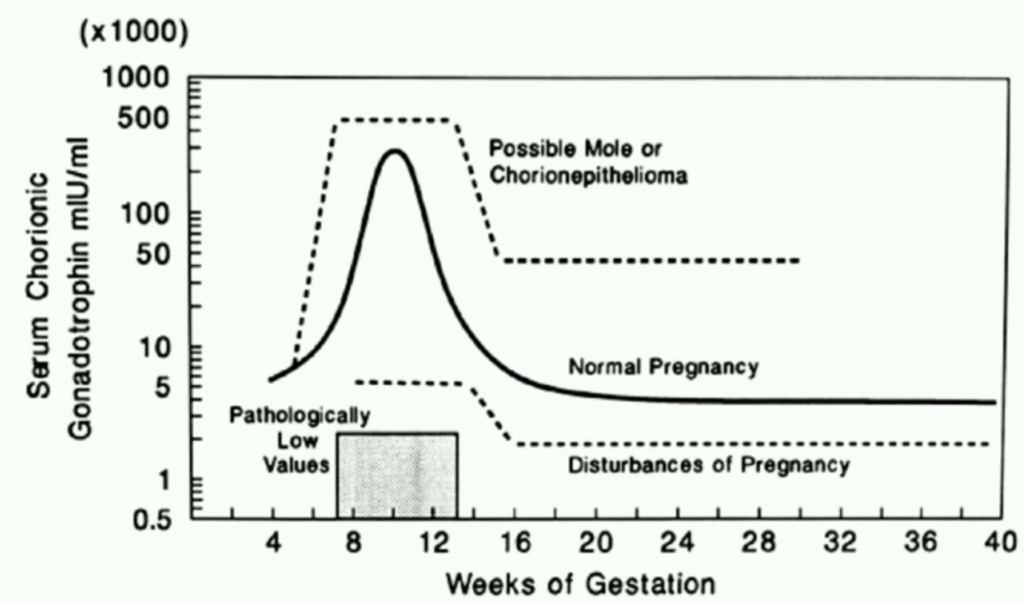
Urine qualitative B-hCG is the best initial test for diagnosing and ruling out pregnancy. Serum quantitative-hCG is an even better test when facilities are available. A positive pregnancy test is usually followed up by an ultrasound.
- Why is ultrasound done after positive clinical hCG
- To confirm pregnancy
- To locate the gestational sac (should hopefully be in the uterus)
- Ultrasound findings that confirm a viable intrauterine pregnancy (Transvaginal ultrasound)
- Gestational sac at 4 – 6 weeks LNMP
- Yolk sac 5 weeks LNMP inside the gestational sac
- Fetal pole at 5.5 – 6 weeks LNMP, measuring > 5 mm
- Double decidual sign confirms intrauterine location
- How early can the gestational sac be detected by ultrasound?
- As early as 5 weeks LNMP
- How early can fetal heart motion be visualized by ultrasound?
- As early as 6 weeks LNMP, which is extraordinarily early come to think about it…
- Normal fetal heart rate begins at around 10 weeks LNMP.
- How early can fetal heart sounds be auscultated?
- Towards the end of the first trimester
Quantitative Human Chorionic Gonadotropin (hCG)
Inaccurate dating is the most common cause of abnormal quantitative hCG.
Causes of abnormal quantitative hCG
| Abnormal quantitative hCG | Causes |
|---|---|
| Low quantitative hCG | Inaccurate dating, ectopic pregnancy, threatened abortion, missed abortion |
| High quantitative hCG | Inaccurate dating, multiple gestations, molar pregnancy, choriocarcinoma, embryonal carcinoma |
Dating the Pregnancy
Pregnancy is dated from the beginning of the first day of the cycle during which the woman becomes pregnant OR the date of the last normal menstrual period (LNMP)
The most accurate means of determining the Estimated Date of Confinement/Delivery (EDC/EDD) is the first-trimester ultrasound.
Naegele’s rule is used to determine the due date. Subtract 3 months from the LNMP and add 7 days and 1 year (assuming a 28-day cycle)
| Event | Corresponding Gestation By Date |
|---|---|
| Ovulation | 2 weeks LNMP (28-day cycle), 1 weeks LNMP (21-day cycle), 3 weeks LNMP (35-day cycle) |
| Conception | 2 weeks LNMP |
| Implantation | 3 weeks LNMP |
| 1st positive B-hCG | 3 weeks LNMP (1 week after conception) |
| Typically discovers pregnancy | 4 – 5 weeks LMP (after missing her normal period) |
Cycle lengthS
The follicular phase varies. The luteal phase is fixed/constant at around 14 days.
| Cycle length | Follicular phase length |
|---|---|
| 28 day cycle | 14 days |
| 21 day cycle | 7 days |
| 35 day cycle | 21 days |
Gravidity
Gravidity is the state of being pregnant
| Term | Definition |
|---|---|
| Gravida | A woman who is pregnant |
| Nulligravida | A woman who has never been pregnant |
| Primigravida | A woman who is in her first pregnancy |
| Multigravida | A woman who has had two or more pregnancies |
Parity
Parity is the number of pregnancies in which the fetus(es) have reached the point of viability. It is normally assigned 24 weeks or 500 g in unknown duration (WHO). For resource limited settings (NICU unavailable) it is normally assigned at 28 weeks.
| Term | Definition |
|---|---|
| Nullipara | A woman who has never completed a pregnancy beyond the state of fetal viability |
| Primipara | A woman who has completed one pregnancy beyond the stage of fetal viability |
| Multipara | A woman who has completed multiple pregnancies beyond the stage of fetal viability |
Term
| Term | Definition |
|---|---|
| Preterm | A pregnancy that has reached 24 weeks LMP but before 37 weeks LMP |
| Term | A pregnancy from 37 weeks LMP to 42 weeks LMP |
| Early Term | A pregnancy from 37 0/7 to 37 6/7 weeks LMP |
| Full Term | A pregnancy from 38 0/7 to 40 6/7 weeks LMP |
| Late Term | A pregnancy from 41 0/7 to 41 6/7 weeks LMP |
| Post Term | A pregnancy after 42 weeks LMP |
| Post Date | A pregnancy after 40 weeks LMP |
| Miscarriage/Abortion | Delivery of a dead fetus(es) before 20 weeks LMP |
| Stillbirth | Delivery of a dead fetus(es) after 20 weeks LMP |
GPA System
- G (gravida)
- Total number of known pregnancies the woman has had, including the current ne, regardless of outcome
- P (para)
- Total number of pregnancies the woman has had that led to a birth of an infant after 20 weeks LMP OR greater than 500g
- Multiple gestations are considered one pregnancy
- A (abortus)
- Number of pregnancies that resulted in spontaneous or induced abortions
- Abortus = delivery of a dead fetus(es) before 20 weeks LMP
- Number of pregnancies that resulted in spontaneous or induced abortions
G/TPAL system
- G (gravida)
- Total number of known pregnancies the woman has had. Including the current one. Regardless of the outcome.
- Multiple gestations count as one pregnancy
- T (term)
- Number of pregnancies that result in a term delivery.
- Term is considered delivery after 37 weeks.
- P (preterm)
- Number of pregnancies that resulted in a preterm delivery
- A (abortus)
- Number of pregnancies that resulted in spontaneous or induced abortions
- L (living)
- Number of live infants born (babies that were alive coming out)
Practice Questions
- What is the due date for LMP: 19/12/2022
- EDD 26/09/2023
- Shiru is 8 weeks pregnant. It is her first known pregnancy.
- Primigravida (P 0+0 G1)
- G1 P0 A0
- G1 T0 P0 A0 L0 (G1 0000)
- Shiru later gives birth to a live boy at 40 weeks gestation via spontaneous vertex delivery
- Now P1+0
- G1 P1 A0
- G1 T1 P0 A0 L1 (G1 1001)
- Karimi has just given birth to a live girl at 32 weeks gestation via cesarean delivery. It was her first known pregnancy.
- Now P1+0
- G1 P1 A0
- G1 T0 P1 A0 L1 (G1 0101)
- Moraa is 15 weeks pregnant. It is her third known pregnancy. Her first pregnancy resulted in a spontaneous vertex delivery at 39 weeks and her second pregnancy was a Caesarean at 40 weeks.
- P2+0 G3
- G3 P2 A0
- G3 T2 P0 A0 L2 (G3 2002)
- Tandi is 26 weeks pregnant. It is her fourth known pregnancy. Her first pregnancy ended in a miscarriage at 10 weeks. The second resulted in a spontaneous vertex delivery of live twin boys at 38 weeks. The third resulted in a spontaneous vertex delivery of a live girl at 35 weeks.
- P2+1 G4
- G4 P2 A1
- G4 T1 P1 A1 L3 (G4 P1113)
- Aysha gave birth to a live girl at 39 weeks, live twin boys at 34 weeks, had a miscarriage at 8 weeks, then a live boy at 31 weeks. She is now pregnant.
- P3+1 G5
- G5 P3 A1
- G5 T2 P1 A1 L4 (G5 P2114)
- Agutu presents to the clinic and is confirmed to have an intrauterine pregnancy via ultrasound. She says that her last day of bleeding was 9/7/2022. She has regular 28-day periods. She wants to know her due date.
- Estimated Date of Delivery: 16/4/2023
- A woman is on her 4th pregnancy. Has previously delivered one live singleton at 40w0d, one live singleton at 35w5d, and one live set of twins at 34w7d.
- G4 P3 A0 or
- P3+0 G4
- A woman is on her 4th pregnancy. Has previously delivered one live singleton at 40w0d, one live singleton at 35w5d, and one live set of twins at 34w7d.
- G4 T1 P2 A0 L4 or
- G4 1204
- P3 + 0 G4