Endometrial Hyperplasia

Last updated: November 11, 2024
Table Of Contents

Add a header to begin generating the table of contents

Endometrial hyperplasia is endometrial thickening with a proliferation of irregularly sized and shaped glands. Tends to be symptomatic in post-menopausal women. Endometrial hyperplasia in a post-menopausal woman (around 10mm) would be a normal endometrial thickness for a pre-menopausal woman in the secretory phase of her cycle. The class of hyperplasia is determined by histology. Endometrial tissue is extremely responsive to estrogen. Hyperplasia may be a precancerous lesion, although a majority do not develop into adenocarcinoma. Treatment depends on the age of the woman and whether or not there is atypia. MDPA or Megestrol is the medical treatment of choice.

1 in 38 women will develop endometrial cancer in their lifetime.

  • Risk factors
    • Hyperestrogenism (unopposed estrogen)
      • High-dose menopausal estrogens
      • Obesity (more aromatase more estrogen)
      • Nulliparity
      • Early menarche (≤ 11 years)
      • Late menopause
      • Use of Tamoxifen (SERM given for ER+ Breast cancer. Estrogen agonist in the uterus)
      • PCOS (anovulation → unopposed estrogen)
    • Type 2 diabetes, Hypertension, and Gallbladder Disease (may be independent, but occur more commonly in obese women)
    • White race
    • High socio-economic sttus
    • Older age
    • Living in North America or Northern Europe
  • Patient History
    • Use of post-menopausal estrogen supplements
    • Use of Tamoxifen
    • Nulliparity
    • Early onset of menarche and Late menopause
    • Family History of malignancies (Lynch syndrome etc.)
    • Ensure that pap smear is up to date
  • Signs and Symptoms
    • Abnormal uterine bleeding
      • Post-menopausal women: Post-menopausal bleeding
      • Pre-menopausal women: Menorrhagia, Intermenstrual spotting
  • Physical Exam
    • Pelvic exam (bimanual and speculum): feel for masses (fibroid, polyps, ovarian tumours), exclude lacerations, foreign bodies, cervical cancer
  • Investigations
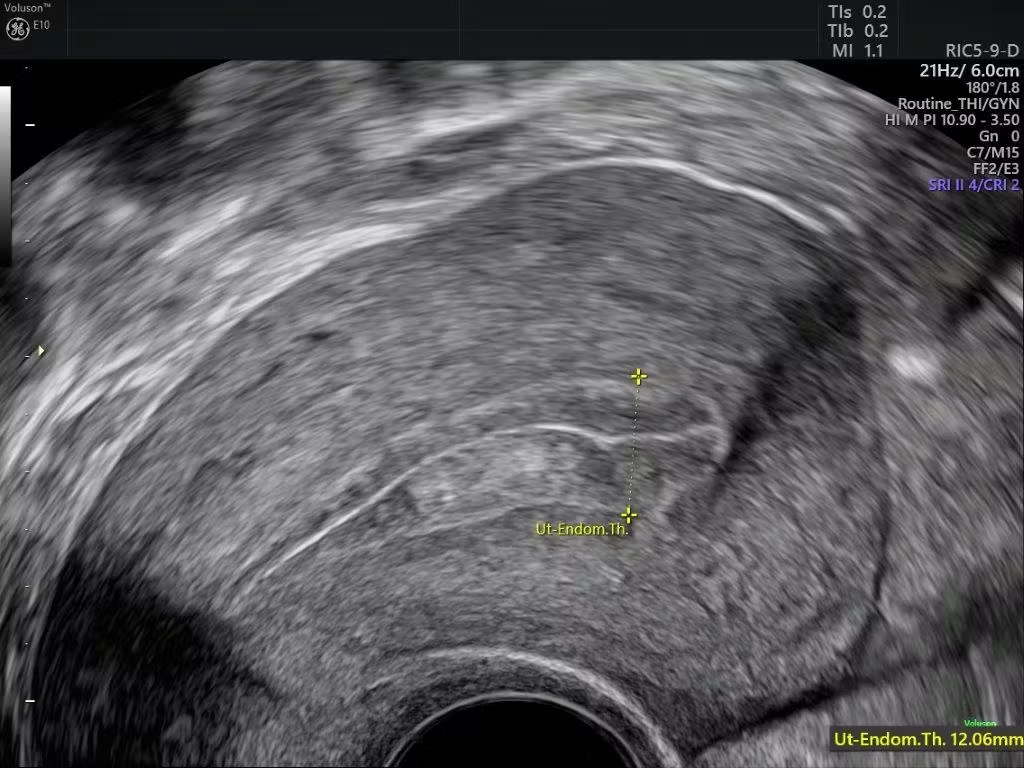
    • Transvaginal ultrasound: measure the endometrial stripe. Imaging modality of choice.
      • For post-menopausal women:
        • Endometrial stripe < 5mm: Likely endometrial atrophy
        • Endometrial stripe ≥ 5 mm: Likely endometrial hyperplasia
      • For pre-menopausal women
        • Normal endometrium varies from 4 – 16 mm
    • Endometrial biopsy
    • Labs:
      • Qualitative hCG
      • CBC (haemoglobin)
      • TFTs
  • Indications for endometrial biopsy
    • Age > 40 years
    • Risk factors for endometrial carcinoma
    • Significant intermenstrual bleeding
    • Failure of medical treatment for abnormal bleeding

Terms used to describe the histology of endometrial hyperplasia

TermDescription
SimpleNormal endometrial architecture but increased glands and stroma (ratio may be slighly increased > 1:1)
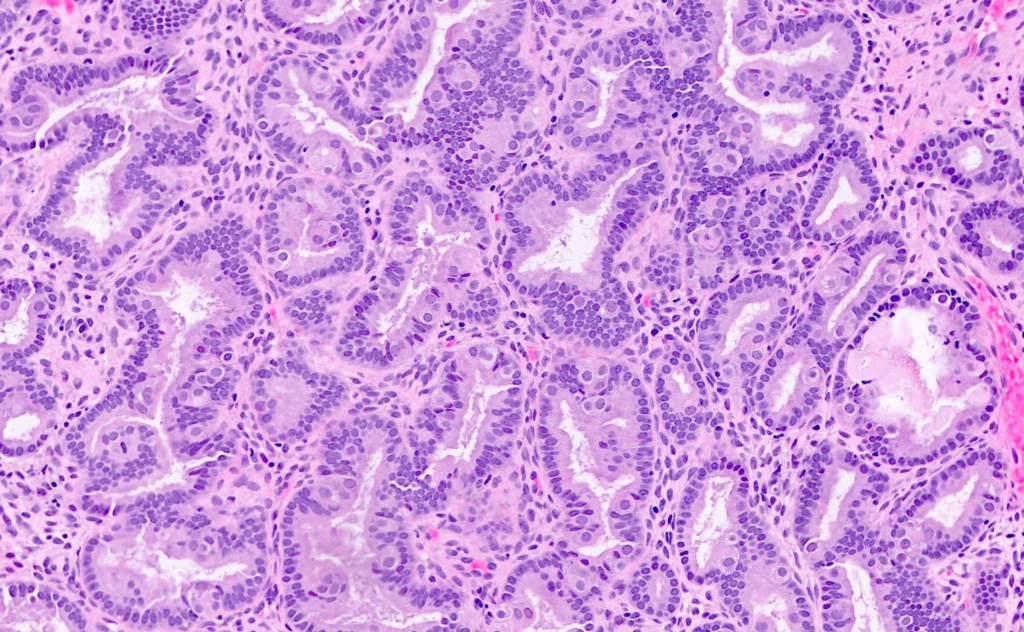
ComplexChanges in endometrial architecture (crowding, invaginations) and/or increased gland to stroma ratio (> 3:1)
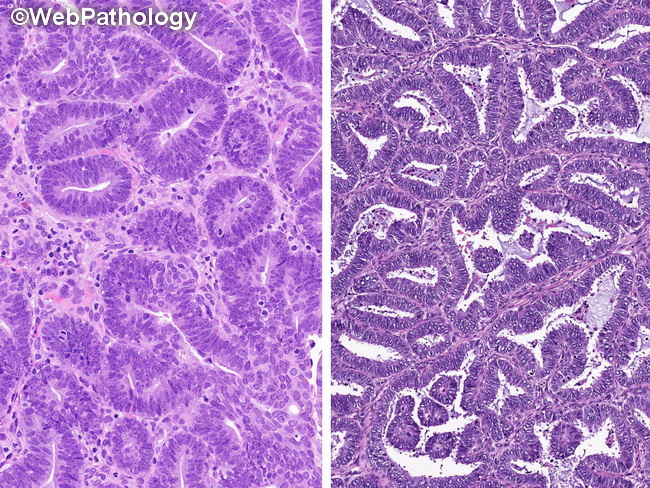
AtypiaChanges in the nuclear structure of the cells (prominent nucleoli, salt-pepper chromatin, mitotic figaures etc…)

Risk of progression to cancer

HistologyRisk
Simple without atypia1%
Complex without atypia3%
Simple with atypia8%
Complex with atypia29%
  • Treatment for hyperplasia with NO atypia
    • Premenopausal: MDPA 10-20 mg qd for 12-14 days q1mos for 3-6 months
    • Postmenopausal: MDPA 2.5 mg qd continuously for 3-6 months
    • Stop progestins then Repeat biopsy after 2-6 weeks (when tissue returns to normal)
    • If no response, MDP 40-100 mg qd or Megestrol 160 mg qd
  • Treatment for hyperplasia with atypiaThe risk of cancer is so high
    • Hysterectomy (most patients will be postmenopausal)
    • High dose MDPA if preservation of fertility* (ability to bear children) is desired in premenopausal women
Endometrial hyperplasia on ultrasound
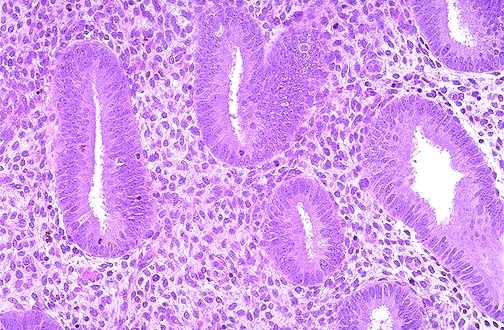
Endometrial biopsy
Endometrial biopsy
Normal endometrial tissue
Complex endometrial hyperplasia
Nonatypical vs Atypical endometrial hyperplasia
Non-atypical vs Atypical endometrial hyperplasia
Simple vs Complex hyperplasia
Reference Intervals
Biochemistry
ACTHP: <80 ng/L
ALTP: 5–35 U/L
AlbuminP: 35–50 g/L
AldosteroneP: 100–500 pmol/L
Alk. phosphataseP: 30–130 U/L
α-AmylaseP: 0–180 IU/dL
α-FetoproteinS: <10 kU/L
Angiotensin IIP: 5–35 pmol/L
ADHP: 0.9–4.6 pmol/L
ASTP: 5–35 U/L
BicarbonateP: 24–30 mmol/L
BilirubinP: 3–17 μmol/L
BNPP: <50 ng/L
CRPP: <10 mg/L
CalcitoninP: <0.1 mcg/L
Calcium (ionized)P: 1.0–1.25 mmol/L
Calcium (total)P: 2.12–2.60 mmol/L
ChlorideP: 95–105 mmol/L
CholesterolP: <5.0 mmol/L
VLDLP: 0.128–0.645 mmol/L
LDLP: <2.0 mmol/L
HDLP: 0.9–1.93 mmol/L
Cortisol AMP: 450–700 nmol/L
Cortisol MidnightP: 80–280 nmol/L
CK ♂P: 25–195 U/L
CK ♀P: 25–170 U/L
CreatinineP: 70–100 μmol/L
FerritinP: 12–200 mcg/L
FolateS: 2.1 mcg/L
FSHP: 2–8 U/L ♂; >25 menopause
GGT ♂P: 11–51 U/L
GGT ♀P: 7–33 U/L
Glucose (fasting)P: 3.5–5.5 mmol/L
Growth hormoneP: <20 mu/L
HbA1C (DCCT)B: 4–6%
HbA1C (IFCC)B: 20–42 mmol/mol
Iron ♂S: 14–31 μmol/L
Iron ♀S: 11–30 μmol/L
Lactate (venous)P: 0.6–2.4 mmol/L
Lactate (arterial)P: 0.6–1.8 mmol/L
LDHP: 70–250 U/L
LHP: 3–16 U/L
MagnesiumP: 0.75–1.05 mmol/L
OsmolalityP: 278–305 mosmol/kg
PTHP: 0.8–8.5 pmol/L
PotassiumP: 3.5–5.3 mmol/L
Prolactin ♂P: <450 U/L
Prolactin ♀P: <600 U/L
PSAP: 0–4 mcg/mL
Protein (total)P: 60–80 g/L
Red cell folateB: 0.36–1.44 μmol/L
Renin (erect)P: 2.8–4.5 pmol/mL/h
Renin (recumbent)P: 1.1–2.7 pmol/mL/h
SodiumP: 135–145 mmol/L
TBGP: 7–17 mg/L
TSHP: 0.5–4.2 mU/L
T4P: 70–140 nmol/L
Free T4P: 9–22 pmol/L
TIBCS: 54–75 μmol/L
TriglyceridesP: 0.50–2.3 mmol/L
T3P: 1.2–3.0 nmol/L
Troponin TP: <0.1 mcg/L
Urate ♂P: 210–480 μmol/L
Urate ♀P: 150–390 μmol/L
UreaP: 2.5–6.7 mmol/L
Vitamin B12S: 0.13–0.68 nmol/L
Vitamin DS: 50 nmol/L
Arterial Blood Gases
pH7.35–7.45
PaCO₂4.7–6.0 kPa
PaO₂>10.6 kPa
Base excess±2 mmol/L
Urine
Cortisol (free)<280 nmol/24h
Hydroxyindole acetic acid16–73 μmol/24h
Hydroxymethylmandelic acid16–48 μmol/24h
Metanephrines0.03–0.69 μmol/mmol cr.
Osmolality350–1000 mosmol/kg
17-Oxogenic steroids ♂28–30 μmol/24h
17-Oxogenic steroids ♀21–66 μmol/24h
17-Oxosteroids ♂17–76 μmol/24h
17-Oxosteroids ♀14–59 μmol/24h
Phosphate (inorganic)15–50 mmol/24h
Potassium14–120 mmol/24h
Protein<150 mg/24h
Protein/creatinine ratio<3 mg/mmol
Sodium100–250 mmol/24h
Haematology
WCC4.0–11.0 ×10⁹/L
RBC ♂4.5–6.5 ×10¹²/L
RBC ♀3.9–5.6 ×10¹²/L
Hb ♂130–180 g/L
Hb ♀115–160 g/L
PCV ♂0.4–0.54 L/L
PCV ♀0.37–0.47 L/L
MCV76–96 fL
MCH27–32 pg
MCHC300–360 g/L
RDW11.6–14.6%
Neutrophils2.0–7.5 ×10⁹/L (40–75%)
Lymphocytes1.0–4.5 ×10⁹/L (20–45%)
Eosinophils0.04–0.44 ×10⁹/L (1–6%)
Basophils0–0.10 ×10⁹/L (0–1%)
Monocytes0.2–0.8 ×10⁹/L (2–10%)
Platelets150–400 ×10⁹/L
Reticulocytes0.8–2.0% / 25–100 ×10⁹/L
Prothrombin time10–14 s
APTT35–45 s
Paediatric
Pulse Rate (bpm)
Neonate140–160
Infant <1yr120–140
1–5 years110–130
5–12 years80–120
>12 years70–100
Respiratory Rate (tachypnoea)
0–2 months≥60/min
2–12 months≥50/min
1–5 years≥40/min
>5 years≥30/min
Blood Pressure (mmHg)
Term65/45
1 year75/50
4 years85/60
8 years95/65
10 years100/70
Weight Formulas
3–12 months(a + 9)/2 kg
1–6 years2a + 8 kg
>6 years(7a − 5)/2 kg
Haemoglobin (g/dL)
Term newborn13–20
1 month11–18
2 months10–15
1–2 years10–13
>2 years11–14
MUAC (6 months–5 years)
Obese>17.5 cm
Normal13.5–17.4 cm
At risk12.5–13.4 cm
Moderate malnutrition11.5–12.4 cm
Severe malnutrition<11.5 cm
Developmental Milestones
Social smile1.5 months
Head control4 months
Sits unsupported7 months
Crawls10 months
Stands unsupported10–12 months
Walks12–13 months
Talks18 months
CSF WBC (/mm³)
Term newborn0–25
>2 weeks0–5
Calculator

Post Discussion

Your email address will not be published. Required fields are marked *