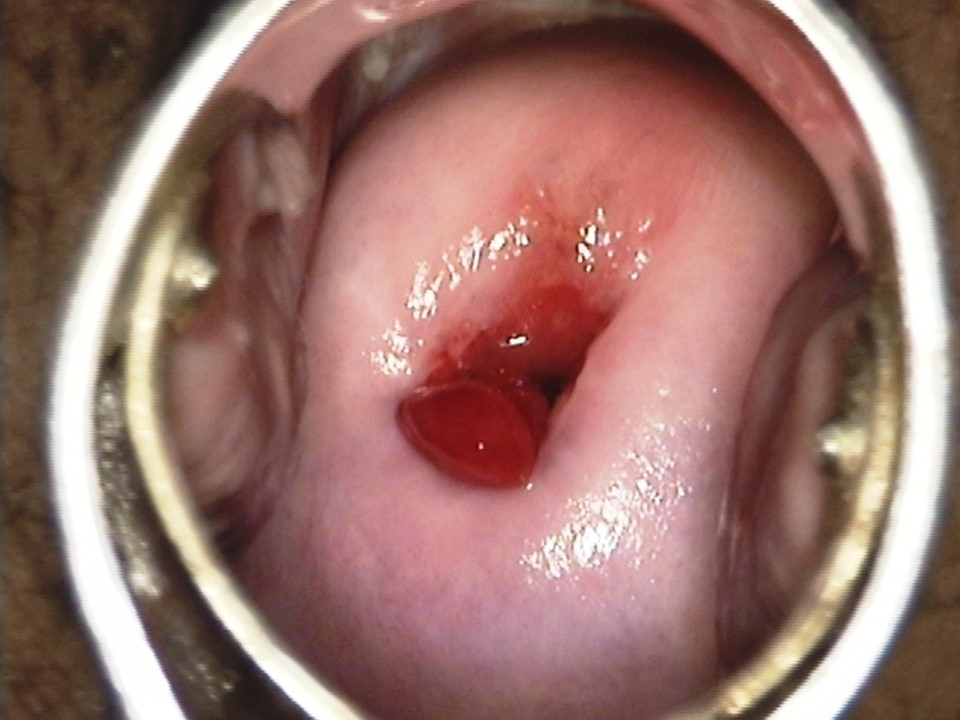
Benign Lesions of the Cervix

Last updated: November 11, 2024

Cervical cysts

Cervical cysts need not be removed unless they are symptomatic or interfere with pap testing.

Benign lesionDescription
Nabothian cystClear to yellow-white elevations of the endocervix or proximal ectocervix. Contain mucus. No more than 1 cm in diameter. Most common cyst
Mesonephric cystRemnants of the Wolffian duct. Extend deeper into the cervical stoma. Commonly found in the ectocervix. Cervical equivalent to Gardner cysts.
EndometriosisRed-purple in appearance. Associated sx worsen within days of menstruation
Nabothian cyst
Nabothian cyst

Cervical polyps

These are asymptomatic and almost always benign. Usually incidental findings on cervical exam are performed for other purposes. Appears as a sessile/pedunculated mass. Tx involves removal since bleeding from polyps can mask other sources of bleeding d/t more problematic causes (e.g. cervical ca, fibroids, adenomyosis, endometrial polyps, endometrial hyperplasia, endometrial cancer).

  • Signs and symptom
    • Postcoital bleeding
    • Intermenstrual bleeding
  • Treatment
    • Polypectomy
Cervical polyp
Cervical polyp

Cervical fibroids

Leiomyomas found in the cervix. Symptoms depend on size. Can be confused with cervical ca.

  • Signs and symptoms
    • Intemenstrual bleeding
    • Dyspareunia
    • Bladder/rectal pressure
    • Ostetric complications
  • Treatment
    • Screen for cervical cancer
    • Monitor w/regular gynecologic visits
    • Elective removal if symptomatic

Cervical stenosis

Cervical stenosis is a narrowing or obliteration of the cervical canal. May be congenital or acquired. Mild cervical stenosis is usually asymptomatic. The inability to pass a 1 – 2 mm probe into the uterine cavity is diagnostic for cervical stenosis.

  • Congenital causes
    • Segmental Mullerian hypoplasia (cf. vaginal atresia)
  • Acquired causes
    • Trauma (OB)
    • Post-op (s/p LEEP, conization, D&C)
    • Infection
    • Radiation
    • Atrophy
  • Signs and symptoms
    • Cryptomenorrhoea
    • Secondary dysmenorrhea
    • Infertility
    • Obstetric complications
  • Treatment
    • Cervical dilation
Reference Intervals
Biochemistry
ACTHP: <80 ng/L
ALTP: 5–35 U/L
AlbuminP: 35–50 g/L
AldosteroneP: 100–500 pmol/L
Alk. phosphataseP: 30–130 U/L
α-AmylaseP: 0–180 IU/dL
α-FetoproteinS: <10 kU/L
Angiotensin IIP: 5–35 pmol/L
ADHP: 0.9–4.6 pmol/L
ASTP: 5–35 U/L
BicarbonateP: 24–30 mmol/L
BilirubinP: 3–17 μmol/L
BNPP: <50 ng/L
CRPP: <10 mg/L
CalcitoninP: <0.1 mcg/L
Calcium (ionized)P: 1.0–1.25 mmol/L
Calcium (total)P: 2.12–2.60 mmol/L
ChlorideP: 95–105 mmol/L
CholesterolP: <5.0 mmol/L
VLDLP: 0.128–0.645 mmol/L
LDLP: <2.0 mmol/L
HDLP: 0.9–1.93 mmol/L
Cortisol AMP: 450–700 nmol/L
Cortisol MidnightP: 80–280 nmol/L
CK ♂P: 25–195 U/L
CK ♀P: 25–170 U/L
CreatinineP: 70–100 μmol/L
FerritinP: 12–200 mcg/L
FolateS: 2.1 mcg/L
FSHP: 2–8 U/L ♂; >25 menopause
GGT ♂P: 11–51 U/L
GGT ♀P: 7–33 U/L
Glucose (fasting)P: 3.5–5.5 mmol/L
Growth hormoneP: <20 mu/L
HbA1C (DCCT)B: 4–6%
HbA1C (IFCC)B: 20–42 mmol/mol
Iron ♂S: 14–31 μmol/L
Iron ♀S: 11–30 μmol/L
Lactate (venous)P: 0.6–2.4 mmol/L
Lactate (arterial)P: 0.6–1.8 mmol/L
LDHP: 70–250 U/L
LHP: 3–16 U/L
MagnesiumP: 0.75–1.05 mmol/L
OsmolalityP: 278–305 mosmol/kg
PTHP: 0.8–8.5 pmol/L
PotassiumP: 3.5–5.3 mmol/L
Prolactin ♂P: <450 U/L
Prolactin ♀P: <600 U/L
PSAP: 0–4 mcg/mL
Protein (total)P: 60–80 g/L
Red cell folateB: 0.36–1.44 μmol/L
Renin (erect)P: 2.8–4.5 pmol/mL/h
Renin (recumbent)P: 1.1–2.7 pmol/mL/h
SodiumP: 135–145 mmol/L
TBGP: 7–17 mg/L
TSHP: 0.5–4.2 mU/L
T4P: 70–140 nmol/L
Free T4P: 9–22 pmol/L
TIBCS: 54–75 μmol/L
TriglyceridesP: 0.50–2.3 mmol/L
T3P: 1.2–3.0 nmol/L
Troponin TP: <0.1 mcg/L
Urate ♂P: 210–480 μmol/L
Urate ♀P: 150–390 μmol/L
UreaP: 2.5–6.7 mmol/L
Vitamin B12S: 0.13–0.68 nmol/L
Vitamin DS: 50 nmol/L
Arterial Blood Gases
pH7.35–7.45
PaCO₂4.7–6.0 kPa
PaO₂>10.6 kPa
Base excess±2 mmol/L
Urine
Cortisol (free)<280 nmol/24h
Hydroxyindole acetic acid16–73 μmol/24h
Hydroxymethylmandelic acid16–48 μmol/24h
Metanephrines0.03–0.69 μmol/mmol cr.
Osmolality350–1000 mosmol/kg
17-Oxogenic steroids ♂28–30 μmol/24h
17-Oxogenic steroids ♀21–66 μmol/24h
17-Oxosteroids ♂17–76 μmol/24h
17-Oxosteroids ♀14–59 μmol/24h
Phosphate (inorganic)15–50 mmol/24h
Potassium14–120 mmol/24h
Protein<150 mg/24h
Protein/creatinine ratio<3 mg/mmol
Sodium100–250 mmol/24h
Haematology
WCC4.0–11.0 ×10⁹/L
RBC ♂4.5–6.5 ×10¹²/L
RBC ♀3.9–5.6 ×10¹²/L
Hb ♂130–180 g/L
Hb ♀115–160 g/L
PCV ♂0.4–0.54 L/L
PCV ♀0.37–0.47 L/L
MCV76–96 fL
MCH27–32 pg
MCHC300–360 g/L
RDW11.6–14.6%
Neutrophils2.0–7.5 ×10⁹/L (40–75%)
Lymphocytes1.0–4.5 ×10⁹/L (20–45%)
Eosinophils0.04–0.44 ×10⁹/L (1–6%)
Basophils0–0.10 ×10⁹/L (0–1%)
Monocytes0.2–0.8 ×10⁹/L (2–10%)
Platelets150–400 ×10⁹/L
Reticulocytes0.8–2.0% / 25–100 ×10⁹/L
Prothrombin time10–14 s
APTT35–45 s
Paediatric
Pulse Rate (bpm)
Neonate140–160
Infant <1yr120–140
1–5 years110–130
5–12 years80–120
>12 years70–100
Respiratory Rate (tachypnoea)
0–2 months≥60/min
2–12 months≥50/min
1–5 years≥40/min
>5 years≥30/min
Blood Pressure (mmHg)
Term65/45
1 year75/50
4 years85/60
8 years95/65
10 years100/70
Weight Formulas
3–12 months(a + 9)/2 kg
1–6 years2a + 8 kg
>6 years(7a − 5)/2 kg
Haemoglobin (g/dL)
Term newborn13–20
1 month11–18
2 months10–15
1–2 years10–13
>2 years11–14
MUAC (6 months–5 years)
Obese>17.5 cm
Normal13.5–17.4 cm
At risk12.5–13.4 cm
Moderate malnutrition11.5–12.4 cm
Severe malnutrition<11.5 cm
Developmental Milestones
Social smile1.5 months
Head control4 months
Sits unsupported7 months
Crawls10 months
Stands unsupported10–12 months
Walks12–13 months
Talks18 months
CSF WBC (/mm³)
Term newborn0–25
>2 weeks0–5
Calculator

Post Discussion

Your email address will not be published. Required fields are marked *